Salesmsg Review (2026)Calls Eat the Text Credits
 By Daan Haket · Researched and written with an AI assistant · who does what
Calling now runs on the same meter as texting — 1 credit a minute, 2 a minute when forwarding — so voice minutes eat the allowance you budgeted for messages.
sales and service teams that want two-way texting and calling in one CRM-linked inbox, and can estimate their monthly credit burn — messages plus call minutes — before they sign.
your audience doesn't respond to SMS, or your volume is low enough that the fixed 10DLC overhead outweighs the sending. Also skip it if you need a lot of seats cheaply. And skip it if your real usage lands in the gap between the $25 and $329 plans, since the only bridge on offer is a bigger credit bundle on the small plan.
Transparency: the “Visit” links on this page are affiliate links — we may earn a commission if you sign up, at no extra cost to you. No vendor can pay for a better review or verdict. How we make money →
Pricing (2026)
✓ Pricing re-verified 13 Oct 2026
(2026-08-08, re-verified 10 September 2026 and again 13 October 2026 on www.salesmessage.com/pricing in both billing modes) Repackaged since our last check into two named plans plus Enterprise, metered in message credits. Monthly billing: Basic is $25 a month for 500 credits a month; Pro is $329 a month for 10,000 credits a month; Enterprise is contact-for-pricing with custom credits. Both plans carry a credits dropdown that raises the allowance for a fixed add-on.
On Basic, 1,000 credits is +$24, 2,500 is +$74, 5,000 is +$154 and 7,500 is +$224 a month. On Pro the ladder runs from 15,000 credits at +$150 up to 50,000 at +$1,170 a month, in 5,000-credit steps. Annual billing is shown as two months free. Basic is $21 a month billed yearly for 6,000 credits a year (12,000 credits +$252, 30,000 +$756, 60,000 +$1,560, 90,000 +$2,268), and Pro $277 a month billed yearly for 120,000 credits a year (180,000 +$1,512, rising to 600,000 at +$11,796).
Full pricing notes (2 more paragraphs)
Seats and numbers are priced apart from the plan: the first seat is free and each additional seat is $10.00 a month or $100.00 a year; the first number is free and each additional number is $5.00 a month or $50.00 a year. The page defines the meter itself: SMS is 1 credit per 160 characters, MMS is 2 credits, calling is 1 credit a minute and call forwarding is 2 credits a minute.
A 14-day free trial runs, and a 30-day money-back guarantee is offered, refunded less the message credits used. The page no longer publishes a per-credit overage rate, nor terms for taxes, carrier fees or country availability, so we quote none.
Plans change — always verify the live price on their site.
Category context: Communication & Voice. Across the 22 tools in this category that we researched with a public US-dollar price, the median entry price is about $30 a month (lowest paid plan as listed, per seat where the vendor prices per seat). Salesmsg’s entry price of $25 a month sits below that median. Compare pricing conditions in the Software Cost Atlas →
Conditional: Confirmed in writing by Salesmsg, 27 Jul 2026. Not tested by us at a checkout.
What the pricing page doesn’t say
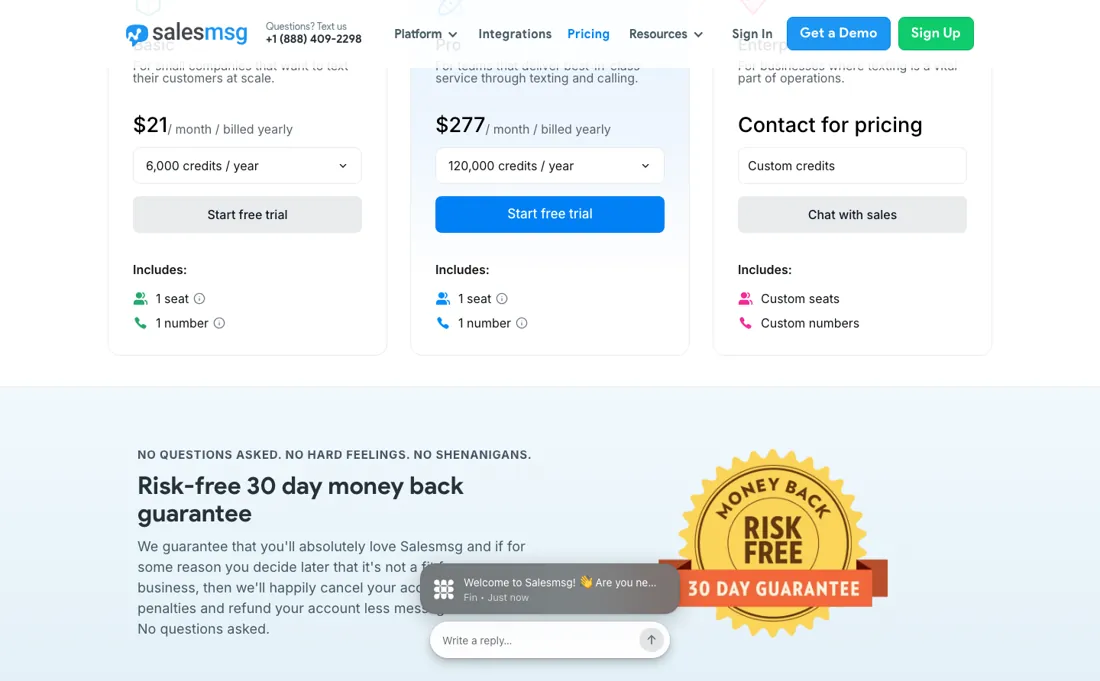
The plan ladder is a canyon: $25 to $329 a month with nothing between them, and the credits dropdown raises your allowance without adding a single seat. Size the credits, not the headcount. An MMS is 2 credits, so one picture message to 1,000 contacts is 2,000 credits — four times the entire monthly allowance on Basic. Seats and numbers bill on top of every plan beyond the first of each: a five-person team on one number is $40 a month over the sticker, and the annual headline of $21 and $277 is a per-month display of a bill charged yearly.
Note what the page has stopped saying since our previous check: there is no published per-credit overage rate anymore, so what happens when you run out mid-cycle is not stated where you buy — ask before you commit. And US business texting carries a regulatory layer of its own: 10DLC registration and carrier surcharges bill separately from anything quoted here, and opt-in and opt-out handling stays your legal responsibility — the platform enables compliance, it does not absolve you.
Watch the video review
The video version of this review, from our YouTube channel.
⚡ Short on time? Watch the 30-second verdict Short.
What Salesmsg does
Business texting and SMS marketing in one shared inbox. Reach customers where they actually reply — two-way texting, automation and team collaboration.
What buyers report about Salesmsg
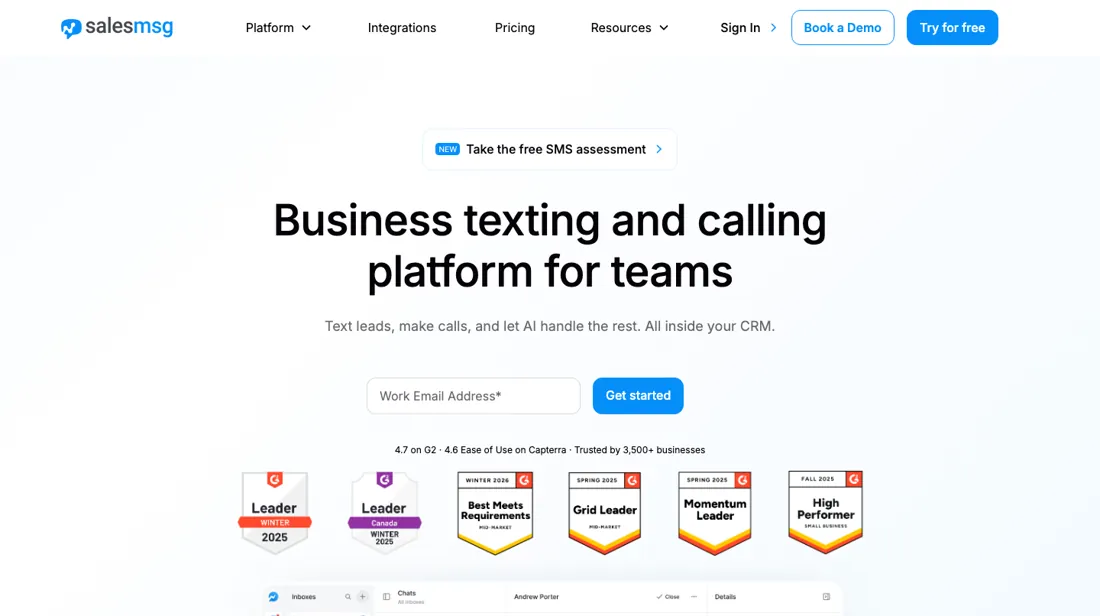
Hands-on: not tested by usReported by buyers: G2, Capterra, GetApp and Trustpilot, read August 2026
Themes from the buyer-review sites listed at the foot of this page, read in August 2026. We have not run Salesmsg ourselves, so this is other buyers' experience rather than ours. We summarise it here because the complaints are usually the part a vendor page leaves out.
- • The shared inbox is easy enough that teams are running the same day — the most common praise across B2B platforms, where it sits around 4.6 to 4.7.
- • CRM sync with HubSpot and Salesforce is the single most-praised feature, with voice calling in the same place as texting.
- • Credit-based pricing: $25 a month for 500 credits at the bottom, $329 a month for 10,000 on Pro. Reviewers report surprise costs once real volume starts.
- • Value for money scores lower than the other categories, and the gap widens as teams scale.
- • Mobile app bugs come up occasionally.
Where the ratings disagree. Around 4.6 on the B2B platforms against 2.8 on Trustpilot. Trustpilot collects the unfiltered end of the experience, and for a credit-metered product that usually means billing.
Pages read (August 2026): Trustpilot
Eight forwarded calls empty the Basic plan
Salesmessage has been repackaged since our last check into two named plans plus Enterprise, and everything is now metered in credits (2026-08-08, re-verified on their own pricing page). Basic is $25 a month for 500 credits; Pro is $329 for 10,000; Enterprise is quoted. Both plans carry a dropdown that raises the allowance for a fixed add-on: on Basic, 1,000 credits is +$24, 2,500 is +$74, 5,000 is +$154 and 7,500 is +$224 a month.
On Pro the ladder runs from 15,000 at +$150 to 50,000 at +$1,170, in 5,000-credit steps. That dropdown matters more than it looks, because the gap between $25 and $329 is usually described as a canyon — including by us. It is not, once you use it: the real ladder is $25, $49, $99, $179, $249, then $329, which is a reasonably smooth climb. The trap is that the middle of the range is a dropdown rather than a plan, so most people never see it and jump straight to Pro.
If you need 5,000 credits, Basic at $179 does it for 46% less than Pro. The unit price barely moves across all of that: $0.050 a credit on Basic's base allowance, $0.033 on Pro's, $0.030 at Pro's 50,000. A hundredfold increase in volume buys a 40% improvement in rate, which is a shallow curve by any standard — so there is no volume argument for buying ahead of your needs.
Now the meter itself, which is where the money actually goes. The page defines it plainly: an SMS is one credit per 160 characters, an MMS is two credits, a call is one credit a minute and call forwarding is two credits a minute. Three consequences follow. Most real marketing texts — a message, a link and an opt-out line — run past 160 characters, so budget two credits each and read Basic's 500 as roughly 250 messages a month.
One picture message to a thousand contacts is 2,000 credits, four times Basic's entire allowance. And because calling now runs on the same meter as texting, eight half-hour forwarded calls exhaust the whole Basic plan before you send a single text. If voice is part of your workflow, the credit count is not a messaging budget at all. Seats and numbers bill separately from every plan: the first of each is free, then $10 a month per extra seat and $5 per extra number, or $100 and $50 a year.
A five-person team on one number is $40 a month over the sticker. Annual billing is shown as two months free — Basic at $21 a month for 6,000 credits a year, Pro at $277 for 120,000 — and note that those are per-month displays of a bill charged yearly. Two gaps to close before you commit. The page no longer publishes a per-credit overage rate, so what happens when you run out mid-cycle is not stated where you buy — ask, in writing.
And US business texting has a regulatory layer that bills outside all of this: 10DLC registration and carrier surcharges are separate, and opt-in and opt-out handling remains your legal responsibility. The platform supports compliance; it does not provide it. There is a 14-day trial and a 30-day money-back guarantee, refunded less the credits you used.
Our monthly capture read this pricing page in August 2026 and again in September 2026. Our 2 August capture still showed the old five-step ladder from $25 to $249 a month. By our 8 August reading the page sold two plans: Basic at $25 and Pro at $329 a month, or $277 a month billed yearly, with everything in between replaced by a credits dropdown and published add-on rates of $10 per extra seat and $5 per extra number. The September capture carries the $277 figure. Read monthly against monthly, the top of the ladder went from $249 to $329, a 32% rise.
How to actually use Salesmsg
Work out your credit consumption before you pick a plan, because the meter is the product. Count the characters in a real message of yours — most marketing texts with a link and an opt-out line pass 160 and therefore cost two credits, not one. Multiply by your list. Then add voice separately: calls are one credit a minute and forwarded calls two, on the same allowance as your texting.
Open the credits dropdown before you compare plans. The middle of the price range is hidden there rather than published as a tier, so Basic reaches 7,500 credits at $249 — and if 5,000 is your number, Basic at $179 costs 46% less than Pro. Most people never look and jump to $329. Ask two questions in writing during the 14-day trial. What is the per-credit overage rate — the page has stopped publishing it, so what happens when you run out mid-cycle is unknown at the point of purchase.
And confirm what 10DLC registration and carrier surcharges will add, since those bill outside everything quoted on the pricing page. Note that the 30-day money-back guarantee is refunded less the credits you have used, so a heavy first month is not fully reversible.
Where this section comes from: our research notes (232 words)
Salesmsg's own pricing page, www.salesmessage.com/pricing, read 10 September 2026 in a browser in BOTH billing modes. The page opens on the annual column, where Basic is $21 a month billed yearly with 6,000 credits a year and Pro is $277 a month billed yearly with 120,000 credits a year; switching the toggle to Monthly shows Basic at $25 a month with 500 credits a month and Pro at $329 a month with 10,000 credits a month.
Enterprise is contact-for-pricing in both. Every figure our review quotes was confirmed on the page that day: the monthly add-on ladder (1,000 credits +$24, 2,500 +$74, 5,000 +$154, 7,500 +$224 on Basic; 15,000 +$150 through 50,000 +$1,170 in 5,000-credit steps on Pro), its annual equivalents (12,000 +$252, 30,000 +$756, 60,000 +$1,560, 90,000 +$2,268; 180,000 +$1,512 up to 600,000 +$11,796), and the seat and number add-ons ($10.00 a month or $100.00 a year per extra seat, $5.00 or $50.00 per extra number).
The ladder is rendered as a custom dropdown rather than an HTML select element, which is why an automated scan for select elements on 10 September reported it missing; it is in the page. Credit rollover, negative balance and failed-message billing from Salesmsg's help article 'How do message credits work?' (help.salesmessage.com/en/articles/3327206-how-do-message-credits-work), read 13 October 2026; pricing page re-read the same day in both billing modes, base prices, add-on ladders and seat and number prices unchanged.
Salesmsg vs SimpleTexting, side by side
Each column shows the vendor’s own published entry price, read on the date shown. Entry prices can cover different services or units, so check what each one buys. We do not average them into a score.
The SimpleTexting link above is an affiliate link — we may earn a commission if you sign up, at no extra cost to you — and the other column is a plain link. Neither changes what this table says.
The natural comparison is SimpleTexting or Textline — the business-SMS peer group — compare credits-per-dollar AND what the meter counts, now that call minutes draw on the same balance; the sticker rows look more alike than the invoices.
Frequently asked questions
Do unused credits carry over to the next month?
Not the plan's own credits. Salesmsg's help article 'How do message credits work?' (help.salesmessage.com, read 13 October 2026) says subscription credits are replenished each month, or each year on an annual plan, and that unused subscription credits do not roll over. Credits bought through Auto-Recharge are different: the same article says they roll over until they are completely used. So size the plan on a normal month and cover peaks with recharged credits rather than buying a bigger plan to bank allowance.
What happens when my credit balance runs out?
Inbound texts keep arriving. The same help article (read 13 October 2026) says Salesmsg still receives those texts and creates a negative balance, which is deducted when credits are next added; it does not state whether outbound sending stops at zero, so that part is not confirmed. It also says a message that fails to deliver still uses a credit, and that Auto-Recharge lets you set the threshold, the top-up amount and a separate card.
If I cancel in the first month, what do I get back?
The pricing page (read 13 October 2026) offers a 30-day money-back guarantee and says it will cancel the account without penalties and refund it less message credits used. The 14-day free trial comes first, so the guarantee covers the first paid period; credits you have already sent are not refunded.
Is this a hands-on review of Salesmsg?
This is a researched assessment, not a hands-on test — where we've used a tool ourselves, we say so explicitly. We name what each tool is good and bad at, and we earn a commission only if you sign up, at no cost to you.
- Buyer reviews on G2, Capterra, GetApp and Trustpilot, read August 2026.
- 2026-08-08, re-verified 10 September 2026 and again 13 October 2026 on www.salesmessage.com/pricing in both billing modes.
- A dated screenshot of that pricing page, kept on this site as the receipt.
Others in this category
Reviewed communication & voice tools that share ground with Salesmsg — comparable in what they do, not drop-in swaps:
New reviews, price changes we recorded, and the cost conditions we found. No sponsored placements. Unsubscribe anytime.
This is our researched assessment — not a paid placement. The “Visit” links on this page are affiliate links: we may earn a commission if you sign up, at no extra cost to you, and it never changes our take. How we review →