Quo Review (2026)Telecom Taxes in 16 States
 By Daan Haket · Researched and written with an AI assistant · who does what
Call reliability is the recurring complaint — G2 logs hundreds of connection and disconnection reports, and calls get shaky the moment you're off Wi-Fi. Throughout this review we weigh it against RingCentral.
micro-teams of 2–5 people working mostly on Wi-Fi who want a clean, modern phone app built around a shared inbox, with AI call summaries (Sona).
you're scaling past ~10 users and need rock-solid call infrastructure, you make lots of calls off Wi-Fi, or you need video — Nextiva or RingCentral fit better.
Transparency: the “Visit” links on this page are affiliate links — we may earn a commission if you sign up, at no extra cost to you. No vendor can pay for a better review or verdict. How we make money →
Pricing (2026)
✓ Pricing re-verified 11 Oct 2026
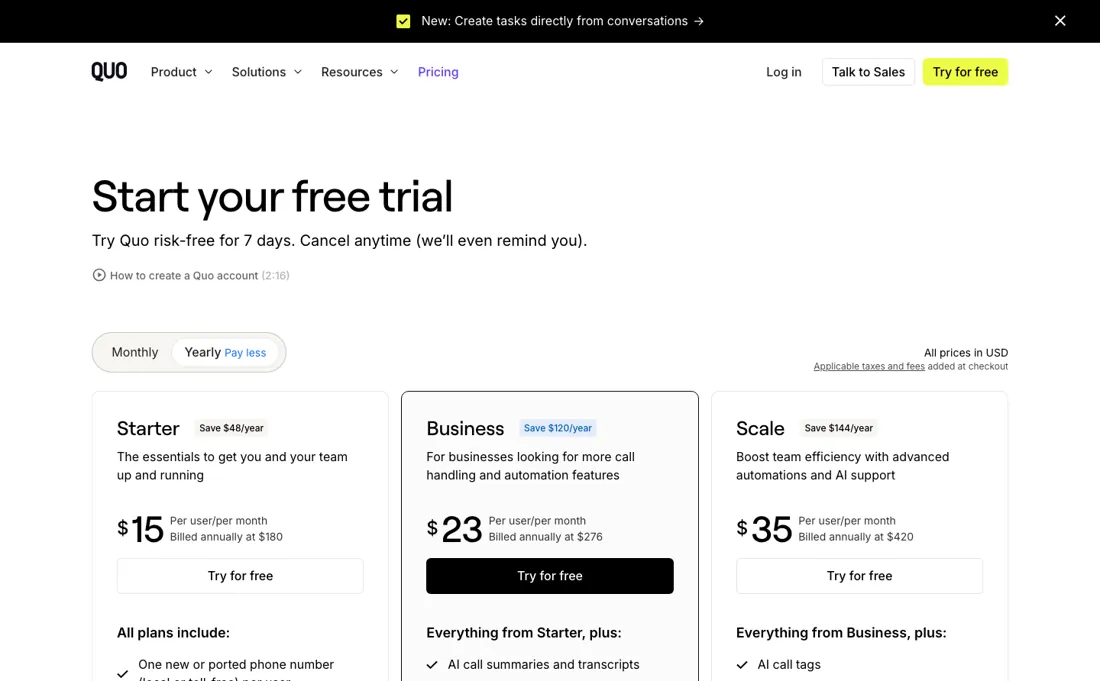
(2026) Three tiers: Starter $15/user/mo annual (billed $180/yr) or $19 monthly; Business $23 annual ($276/yr) or $33 monthly; Scale $35 annual ($420/yr) or $47 monthly. 7-day free trial. Taxes and fees are added at checkout and are not quantified on the page. Itemised extras: The Campaign Registry takes $19.50 once plus $1.50-$3/month to keep US carrier messaging deliverable, each additional phone number is $5/month, and international calling is billed per minute.
The Sona AI answering agent is included on every plan with 1,000 automation credits a month (a call costs 100 credits, so ten calls); more credits run $25/mo for 4,000 up to $199/mo for 60,000, with per-call overage falling from $1.00 to $0.45 across those tiers. Re-verified 11 October 2026 on quo.com/pricing: all six rates, the $180/$276/$420 annual totals, the Sona credit tiers and overage rates, the $19.50 and $1.50-$3 Campaign Registry fees and the $5 extra number are unchanged.
Two lines the earlier reading did not carry: the compare-plans table caps Starter at up to 10 paid users (Business and Scale unlimited), and Quo's help article 'Quo Plans and Pricing' (read 11 October 2026) adds a $15 Campaign Registry resubmission fee if a registration has to be resubmitted and lists the 16 states where telecom taxes are collected, based on your billing address. Plans change — always verify the live price on their site.
Category context: Communication & Voice. Across the 22 tools in this category that we researched with a public US-dollar price, the median entry price is about $30 a month (lowest paid plan as listed, per seat where the vendor prices per seat). Quo’s entry price of $15 a month sits below that median. Compare pricing conditions in the Software Cost Atlas →
Vendor-confirmed: Confirmed in writing by Quo, 27 Jul 2026. Not tested by us at a checkout.
What the pricing page doesn’t say
There's also no video conferencing, no 24/7 support on lower tiers, international calling costs extra, and the CRM integrations are shallow (the HubSpot app scores ~3.3/5).
Watch the video review
The video version of this review, from our YouTube channel.
⚡ Short on time? Watch the 30-second verdict Short.
What Quo does
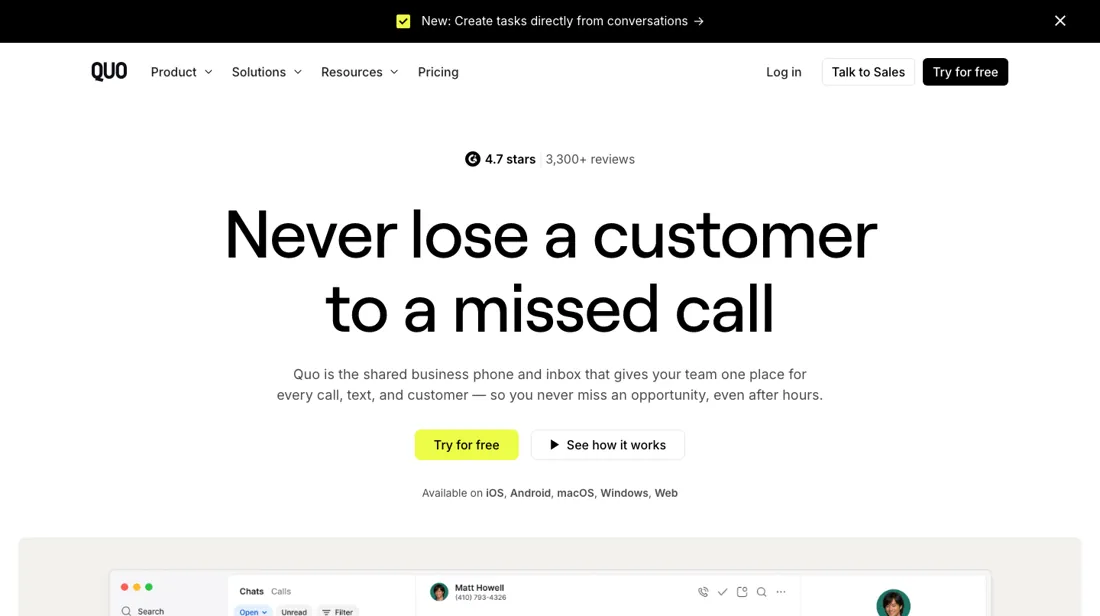
Shared business numbers, texting and AI call summaries for small teams, formerly OpenPhone. Call reliability off Wi-Fi is the recurring complaint, and there is no video conferencing.
What buyers report about Quo
Hands-on: not tested by usReported by buyers: G2, Capterra and practitioner reviews, read August 2026
Themes from the buyer-review sites listed at the foot of this page, read in August 2026. We have not run Quo ourselves, so this is other buyers' experience rather than ours. We summarise it here because the complaints are usually the part a vendor page leaves out.
- • 4.7 across 3,200+ reviews with over 90,000 businesses on it — the interface is what everyone names, and teams say having calls, texts and voicemail in one shared inbox genuinely organises them.
- • The September 2025 rebrand from OpenPhone came with $105M in growth funding, so the company is not going anywhere.
- • The $19 per user headline understates it. A five-person Starter team on annual billing lands around $97-$108 a month rather than the $75 the page implies — 29-44% above sticker.
- • Sona costs extra past 10 free calls a month, and the AI credit pricing frustrates reviewers at scale.
- • Support breaks down exactly when it matters: slow responses, unexpected account flags and unresolved tickets during technical problems.
- • Audio instability and dropped calls on unstable Wi-Fi, which matters if your team works from home.
- • It suits freelancers and micro-teams. Larger teams report hitting scalability and reliability limits.
The sticker is the smallest number on the bill
There are three tiers now, not two. Starter is $15 per user a month on annual billing and $19 monthly. Business is $23 annual and $33 monthly. Scale, which is new, is $35 annual and $47 monthly. The monthly premium is uneven — 27% on Starter, 43% on Business and 34% on Scale — so the middle plan, the one most teams land on, is the one that punishes monthly billing hardest, and nothing on the page frames it that way (price re-verified 2026-08-31 against the vendor's own pricing page).
Then there is everything that is not the sticker. The page says only that applicable taxes and fees are added at checkout, without quantifying them, so a five-person team can price the $75 subscription and nothing else. What is itemised sits lower down: The Campaign Registry takes $19.50 once and $1.50 to $3 a month to keep messaging deliverable to AT&T, T-Mobile and Verizon, every extra phone number is $5 a month, and international calling is per-minute on top.
Budget above the sticker and ask for your own tax rate in writing, because there is no way to see it before you buy. The AI agent is the newest meter. Sona answers calls around the clock and is now included on every plan, but it runs on credits: 1,000 automation credits a month, and a call costs 100. That is ten answered calls a month before you are buying more — $25 a month for forty calls, up to $199 for six hundred, with overage from $1.00 down to $0.45 a call.
For a phone system whose whole promise is not missing calls, ten a month is a trial allowance rather than a feature. What that money is buying is where this gets harder to recommend. Call reliability is the recurring complaint rather than an isolated one — G2 carries hundreds of connection and disconnection reports, and calls get shaky the moment you leave Wi-Fi. For a phone system that is not a feature gap, it is the product.
There is also no video conferencing, no 24/7 support on the lower tiers, and the CRM integrations are shallow — the HubSpot app sits at about 3.3 out of 5. So make the reliability question the whole evaluation and let price come second. If calls hold up on your network, in your building, on the connections your team actually uses, Starter on annual billing is a reasonable price for a business line. If they do not, no tier fixes it.
Our monthly capture read this vendor's pricing page in September 2026 and again in October 2026, and the amounts were the same both times, including $180, $199, $276 and $420 from the pricing above. We keep watching — the registry records what moves.
Questions we checked
Facts about Quo that would change a buying decision, and where we stand on each. An unanswered question does not mean the feature is missing; it means we have not confirmed it yet.
- How long does Quo hold my phone numbers after I cancel? Sources disagree
Applies to: all plans; cancellation.
Why it matters: a number you cannot port out in time is lost, and the two vendor sources give different windows.
Answer: The FAQ on quo.com/pricing (read 11 October 2026) says numbers are saved for 60 days after the paid period ends, with read access to conversations and workspace data. The help article 'Managing your subscription' (read the same day) says numbers are held for 30 days maximum, and 14 days after a failed payment. Plan on the shorter window and start a port before you cancel.
Checked: Quo pricing page FAQ (2026-10-11); Quo help: Managing your subscription (2026-10-11)
Have a public source that answers one of these? How we review explains how we check and correct.
How to actually use Quo
Test call reliability first, and test it badly on purpose. So use the 7-day free trial to make calls from a phone on mobile data, from the building your team actually works in, at the time of day they actually call. Add up the fees that sit outside the sticker before you compare it with anything. The page quantifies none of the taxes — it says only that they are added at checkout — but it does itemise $19.50 once and $1.50 to $3 a month for Campaign Registry messaging registration, $5 a month for every phone number beyond the one per user, and per-minute international calling.
Ask for your own tax rate in writing. Then check the Sona allowance against your actual call volume. Every plan includes 1,000 automation credits a month and an answered call costs 100, so the included allowance is ten calls. If the AI answering is the reason you are buying, price the $25-to-$199 credit tiers in from the start rather than discovering them later. Check the CRM integration on your own CRM rather than on the logo list — the HubSpot app sits at about 3.3 out of 5 — and be clear about what no tier adds: no video conferencing, and no 24/7 support on the lower plans.
Where this section comes from: our research notes (147 words)
Read 31 Aug 2026 through our own European server, because quo.com refuses TLS to our usual client: quo.com/pricing — the three plan cards in both the monthly and the annual state (with 'Billed annually at $180/$276/$420' and the matching $48/$120/$144 yearly savings), the Sona credit table (tiers at $0, $25, $49, $99 and $199 a month for 1,000 to 60,000 credits, with per-call overage from $1.00 to $0.45), the 'All prices in USD / Applicable taxes and fees added at checkout' line, and the compare-plans rows for Campaign Registry fees ($19.50 one-time, $1.50-$3/month) and additional phone numbers ($5/month each).
Note: quo.com/llms.txt returns a 404. Re-verified 11 October 2026 on www.quo.com/pricing (plan cards in both billing states, Sona credit table, compare-plans table and FAQ) and the support.quo.com articles 'Quo Plans and Pricing', 'Managing your subscription', 'Pre-paid credits and usage-based billing' and 'Export data', all read 11 October 2026.
Quo vs Aircall, side by side
Each column shows the vendor’s own published entry price, read on the date shown. Entry prices can cover different services or units, so check what each one buys. We do not average them into a score.
Both names above are affiliate links: we may earn a commission if you sign up, at no extra cost to you. Neither changes what this table says.
The natural comparison is RingCentral or Aircall — the fuller, more reliable but pricier phone systems. Weigh it against RingCentral on the job you actually need done.
Frequently asked questions
What can I take with me if I leave?
Contacts, call logs and message logs, as CSV. Quo's help article 'Export data' (read 11 October 2026) says only workspace Owners can export, files arrive by email within 24 hours and the link expires after 72 hours. Not included: call recordings, call transcripts and AI summaries, voicemail files, images and media attachments, and internal team threads, so anything you need from those has to be saved another way before you go. The same article says workspace data is kept for 30 days after cancellation and then deleted.
If I remove a user mid-cycle, do I still pay for the seat?
Until renewal, yes. The help article 'Managing your subscription' (read 11 October 2026) says a removed member loses access at once, but the seat stays on the subscription to the end of the billing period; you can refill it free before renewal, and an empty seat drops off automatically at renewal. Added users are charged prorated immediately. Upgrades are immediate and prorated, downgrades wait for renewal, and payments already made are non-refundable. Starter is capped at up to 10 paid users (quo.com/pricing, read 11 October 2026).
Are texts sent through Zapier or the API included in the plan?
No. Quo's help article on pre-paid credits (read 11 October 2026) says US and Canadian texts sent from the Quo app are included, but messages sent through the Quo API or an integration such as Make, Zapier or Clay cost $0.01 per segment from a pre-paid Voice & messaging balance, and fail with a 'not enough prepaid credits' error when that balance runs out. Add funds or switch on auto-recharge before you connect an automation.
Is this a hands-on review of Quo?
This is a researched assessment, not a hands-on test — where we've used a tool ourselves, we say so explicitly. We name what each tool is good and bad at, and we earn a commission only if you sign up, at no cost to you.
- Buyer reviews on G2, Capterra and practitioner reviews, read August 2026.
- Price re-verified 2026-08-31 against the vendor's own pricing page; all prices are quoted on the page in USD.
- A dated screenshot of that pricing page, kept on this site as the receipt.
Others in this category
Reviewed communication & voice tools that share ground with Quo — comparable in what they do, not drop-in swaps:
New reviews, price changes we recorded, and the cost conditions we found. No sponsored placements. Unsubscribe anytime.
This is our researched assessment — not a paid placement. The “Visit” links on this page are affiliate links: we may earn a commission if you sign up, at no extra cost to you, and it never changes our take. How we review →