KrispCall Review (2026)$12/mo Seats Yearly + Pay-Per-Call
 By Daan Haket · Researched and written with an AI assistant · who does what
Same honest math as most budget VoIP: the plan buys the platform, the meter buys the conversations — per-minute and per-SMS charges land on top of every seat, so the comparison that matters is call-rate-per-country at your volume. Throughout this review we weigh it against RingCentral.
sales and support teams that need virtual numbers across many countries with a shared dashboard, dialer and CRM hooks at a budget seat price.
your calling is domestic-only at low volume (simpler tools suffice), or you need enterprise reliability guarantees over price.
Transparency: the “Visit” links on this page are affiliate links — we may earn a commission if you sign up, at no extra cost to you. No vendor can pay for a better review or verdict. How we make money →
Pricing (2026)
✓ Pricing re-verified 7 Oct 2026
Since our August reading the plans have been renamed and a tier added: Starter $12 per user/mo billed annually or $15 monthly, for teams up to 5 users; Advance $32 or $40, up to 50 users; Max $48 or $60, with no member limit; Enterprise custom, quoted as volume pricing for 50+ seats. Annual saves 20%, which the page puts at $36, $96 and $144 per user a year; that checks out against the monthly rates.
Each plan includes one free US, Canadian or UK number per user, $1 of testing credit, and a monthly allowance per user: Starter 200 outbound and 200 inbound call minutes and 100 SMS segments; Advance 1,000, 1,000 and 500; Max unlimited calling under a fair-usage policy and 1,000 segments. SMS allowances are pooled across the users on a plan, and the included calling covers local numbers in the US, Canada, UK and Australia.
Additional calls, SMS and numbers are billed at usage rates from a separate credit balance. US business texting needs A2P 10DLC registration at the same price on every plan: $4.50 brand registration and $15 campaign vetting, one-off, plus $1.50 a month for a low-volume campaign or $2 a month for a sole-proprietor campaign. Subscriptions carry a 14-day unconditional refund; add-ons, numbers and credits are non-refundable. Plans change — always verify the live price on their site.
Category context: Communication & Voice. Across the 22 tools in this category that we researched with a public US-dollar price, the median entry price is about $30 a month (lowest paid plan as listed, per seat where the vendor prices per seat). KrispCall’s entry price of $12 a month sits below that median. Compare pricing conditions in the Software Cost Atlas →
What the price did
We capture KrispCall’s own pricing page every month and keep the figures, so this is our record of the page — not a forecast, and not someone else’s summary.
Steady all summer. Our July and August 2026 captures of KrispCall's pricing page carry exactly the same figures: $12 and $15 for Essential, $32 and $40 for Standard, the same $4.50 and $15 one-off A2P 10DLC registration fees, and the same $1.50 a month campaign fee. Re-reading the page on 17 August 2026 returned the same two plans. Three readings, no movement. On 7 October 2026 the per-user prices were unchanged but renamed: Essential became Starter ($12/$15) and Standard became Advance ($32/$40), with a new Max tier at $48/$60 and per-user call and SMS allowances printed on each plan.
What the pricing page doesn’t say
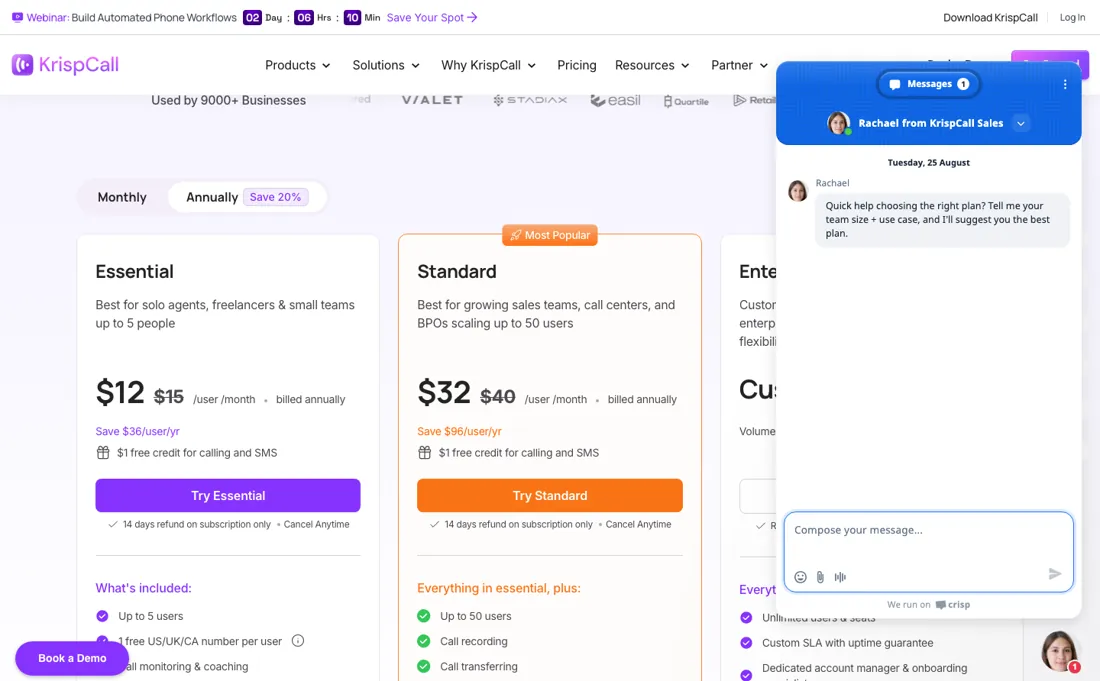
The 100+ country number coverage is genuinely the draw; verify number availability and local regulations for your specific target countries before committing.
Watch the video review
The video version of this review, from our YouTube channel.
⚡ Short on time? Watch the 30-second verdict Short.
What KrispCall does
Virtual numbers across 100+ countries with a shared dashboard, dialer and CRM hooks, priced per user. Calls and SMS are pay-as-you-go from a separate credit balance, so compare per-country call rates at your volume rather than the seat price.
What buyers report about KrispCall
Hands-on: not tested by usReported by buyers: G2, Capterra and Reddit, read August 2026
Themes from the buyer-review sites listed at the foot of this page, read in August 2026. We have not run KrispCall ourselves, so this is other buyers' experience rather than ours. We summarise it here because the complaints are usually the part a vendor page leaves out.
- • Ease of use and support are the top themes on G2, where it sits at 4.5 out of 5 across 375 reviews (read 25 August 2026).
- • Calling runs in the browser with no install, and adding team members is quick.
- • Dropped calls and call quality are the single most-cited complaint across G2 and Capterra. For a phone system, weigh that above everything else here.
- • The $12 to $32 per user headline is not the bill. Every call minute and SMS segment draws from a prepaid balance, and in August 2026 reviewers also counted a fixed monthly charge for each extra number; the pricing page now bills extra numbers at usage rates from the credit balance (see the price section).
- • Analytics are limited and the mobile app draws complaints.
- • There is a documented Reddit astroturfing episode the company attributed to interns. Worth knowing when you read glowing posts about it.
When the paid plan is worth it
KrispCall re-cut its plans after our August reading: Starter ($12 per user a month billed annually, $15 monthly), Advance ($32/$40) and a new Max tier ($48/$60), with Enterprise on quote for 50+ seats. Starter is workable for a team of up to 5 users that needs basic calling, multi-level IVR and the basic integration set, with one free US, Canadian or UK number per user. The first wall is still that 5-user cap: a sixth person forces Advance, which allows up to 50 users and is the first tier with call recording, call transfer, transcripts and summaries, bulk SMS campaigns and Salesforce; the cards label the power dialer an add-on and print no price for it.
Each tier now bundles an allowance per user a month: 200 outbound and 200 inbound minutes plus 100 SMS segments on Starter, 1,000, 1,000 and 500 on Advance, and fair-use unlimited calling with 1,000 segments on Max. A team that regularly runs past Advance's minutes is the case for Max; a team that needs more than 50 users is the case for Enterprise. What upgrading does not fix: calls outside the covered US, Canada, UK and Australia routes, extra numbers and SMS beyond the allowance are still billed at usage rates from a separate credit balance on every plan, and US business texting needs A2P 10DLC registration at the same price on every tier: $4.50 and $15 once, then $1.50 or $2 a month for the campaign.
The page is not internally consistent either: the comparison table further down still lists pay-per-minute calling on every plan, so confirm the allowance in your dashboard before you size a plan around it.
Questions we are still checking
Facts about KrispCall that would change a buying decision, and where we stand on each. An unanswered question does not mean the feature is missing; it means we have not confirmed it yet.
- Do the per-user call minutes and SMS segments on the plan cards apply, or is all calling pay per minute as the comparison table says? Still checking
Applies to: KrispCall pricing page, 7 October 2026: plan cards list 200/1,000/unlimited minutes; the comparison table lists pay per minute on every plan.
Why it matters: decides whether the seat price covers normal calling or is only a floor under a usage bill.
Checked: KrispCall pricing (2026-10-07); KrispCall Helpdesk: Pricing and Plans (2026-10-07)
Have a public source that answers one of these? How we review explains how we check and correct.
How to actually use KrispCall
KrispCall's own guide describes sign-up as a 7-step flow: create the account, verify identity, then buy or port a number and add team members. New accounts start unverified, and the helpdesk states Basic KYC document review finishes within 1-2 hours, with email confirmation once it clears. Until then, an account is capped at 20 outbound SMS total and 5 phone number purchases, which is enough to test the product but not to run a real campaign.
If you already have a number and want to port it in rather than buy new, KrispCall's own porting guide puts the timeline at 1-2 weeks for most numbers, narrowing to 1-10 days for individual local numbers. This is the step most likely to delay an actual go-live date. CRM connections are also tier-gated: Salesforce integration is absent from Starter and first appears on Advance (plan names as of 7 October 2026), so a team planning to wire KrispCall into its CRM from day one needs to budget for that tier before starting onboarding, not after.
Distilled from krispcall.com/pricing and help.krispcall.com help-center articles (read via r.jina.ai reader proxy after direct fetch was Cloudflare-403'd), read 6 Aug 2026. Re-verified 7 October 2026: https://krispcall.com/pricing/ (served HTML: plan cards, comparison table and refund note) and the helpdesk articles How to cancel my KrispCall subscription plan https://help.krispcall.com/en/article/how-to-cancel-my-krispcall-subscription-plan-jz44vz/ and the Pricing and Plans category https://help.krispcall.com/en/category/pricing-and-plans-1j1anni/.
KrispCall vs CloudTalk, side by side
Each column shows the vendor’s own published entry price, read on the date shown. Entry prices can cover different services or units, so check what each one buys. We do not average them into a score.
Both names above are affiliate links: we may earn a commission if you sign up, at no extra cost to you. Neither changes what this table says.
The natural comparison is CloudTalk or CallHippo — the direct budget-VoIP set — differences live in per-country rates and number availability, so price your actual destinations. Weigh it against RingCentral on the job you actually need done.
Frequently asked questions
What does KrispCall cost per user?
Read on 7 October 2026: Starter $12 per user a month on annual billing ($15 monthly), Advance $32 ($40) and Max $48 ($60); Enterprise is quoted. Annual billing saves 20%, which the page states as $36, $96 and $144 per user a year. Starter and Advance are the plans our August reading called Essential and Standard, at the same prices.
Is there a KrispCall promo code?
We have found none, and it is a common search. The published discount is the annual one, 20%, worth $36, $96 or $144 per user a year depending on the plan, plus $1 of testing credit for calls and SMS. Treat any code you find elsewhere with suspicion and check it at checkout.
What are the user limits on each plan?
Starter is capped at 5 users and Advance at 50; Max has no member limit, and Enterprise is priced for 50+ seats. Each user brings one free US, Canadian or UK number and a monthly call and SMS allowance, but usage beyond it, other countries and extra numbers are billed from a separate credit balance on every plan, so the seat price is a floor rather than the bill.
Can I get my money back, and what happens when I cancel?
The pricing page (read 7 October 2026) promises a 14-day unconditional refund on subscription plans only; add-ons, virtual numbers, credits and other one-time purchases are non-refundable. The help-centre cancellation article, last updated in 2023, still says monthly and annual payments already made are non-refundable, so ask for the 14-day terms in writing if you rely on them. An Admin cancels under Settings, Plan Subscription; the account stays active to the end of the paid period, and the request is confirmed by email after review (How to cancel my KrispCall subscription plan, read 7 October 2026).
Are calls and texts included in the plan now?
Partly. Since the re-cut, each plan card lists a monthly allowance per user: 200 outbound and 200 inbound minutes and 100 SMS segments on Starter, 1,000, 1,000 and 500 on Advance, and unlimited calling under a fair-usage policy with 1,000 segments on Max. The calling covers local numbers in the US, Canada, UK and Australia, and SMS segments count for US and Canadian numbers. The comparison table on the same page still says pay per minute on every plan, so this is not confirmed beyond the cards; check your plan's usage screen before relying on it.
Is this a hands-on review of KrispCall?
This is a researched assessment, not a hands-on test — where we've used a tool ourselves, we say so explicitly. We name what each tool is good and bad at, and we earn a commission only if you sign up, at no cost to you.
- Buyer reviews on G2, Capterra and Reddit, read August 2026.
- Re-verified 2026-08-17 and 2026-10-07 against the vendor's own pricing page.
- A dated screenshot of that pricing page, kept on this site as the receipt.
Others in this category
Reviewed communication & voice tools that share ground with KrispCall — comparable in what they do, not drop-in swaps:
New reviews, price changes we recorded, and the cost conditions we found. No sponsored placements. Unsubscribe anytime.
This is our researched assessment — not a paid placement. The “Visit” links on this page are affiliate links: we may earn a commission if you sign up, at no extra cost to you, and it never changes our take. How we review →