CometChat Review (2026)Free to 100 Users, Then $239/mo
 By Daan Haket · Tested hands-on · written with an AI assistant · who does what
The pricing cliff is the honest headline: from a 100-MAU free tier straight to ~$239/mo is a brutal jump for an early-stage app, and users report plan structures changing under them.
product teams that want proven in-app text/voice/video chat with SDKs for every major framework, without building messaging infrastructure themselves.
your app is pre-revenue with growing users (the free-to-paid cliff will hit mid-growth), or chat is peripheral enough that a support widget covers it.
Transparency: the “Visit” links on this page are affiliate links — we may earn a commission if you sign up, at no extra cost to you. No vendor can pay for a better review or verdict. How we make money →
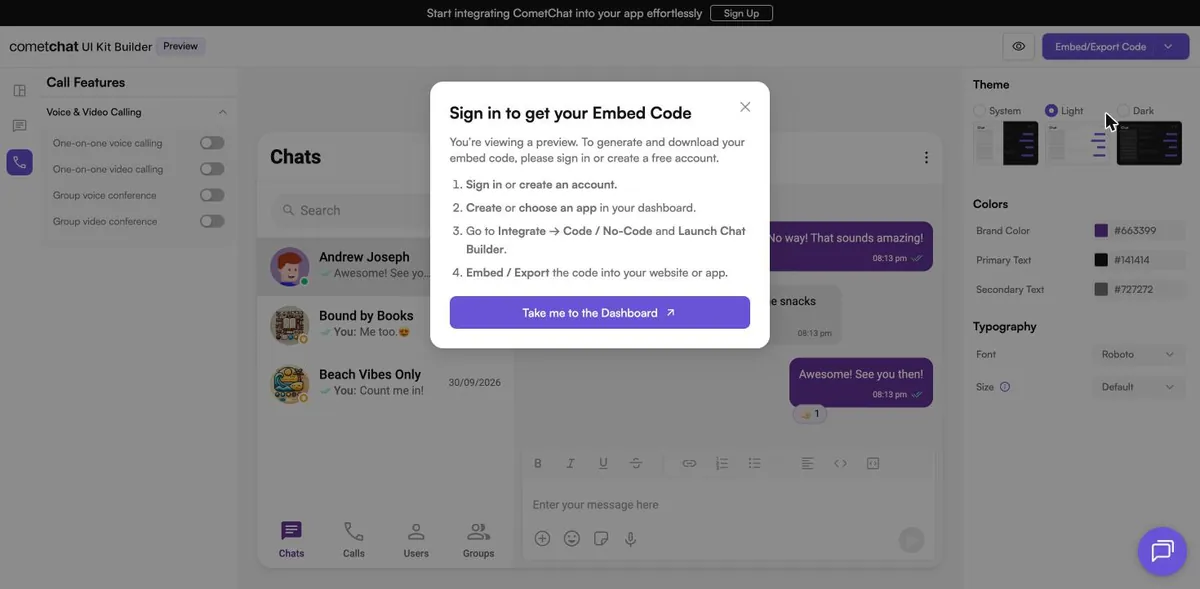
Tested by our team on 23 October 2026 in CometChat's public UI Kit Builder (preview.cometchat.com), without an account: our AI assistant ran the test in Daan's browser. We set our own layout, brand colour and theme, switched read receipts and all calling features on and off, and tried to export the code. No code was run or deployed and no messages were sent.
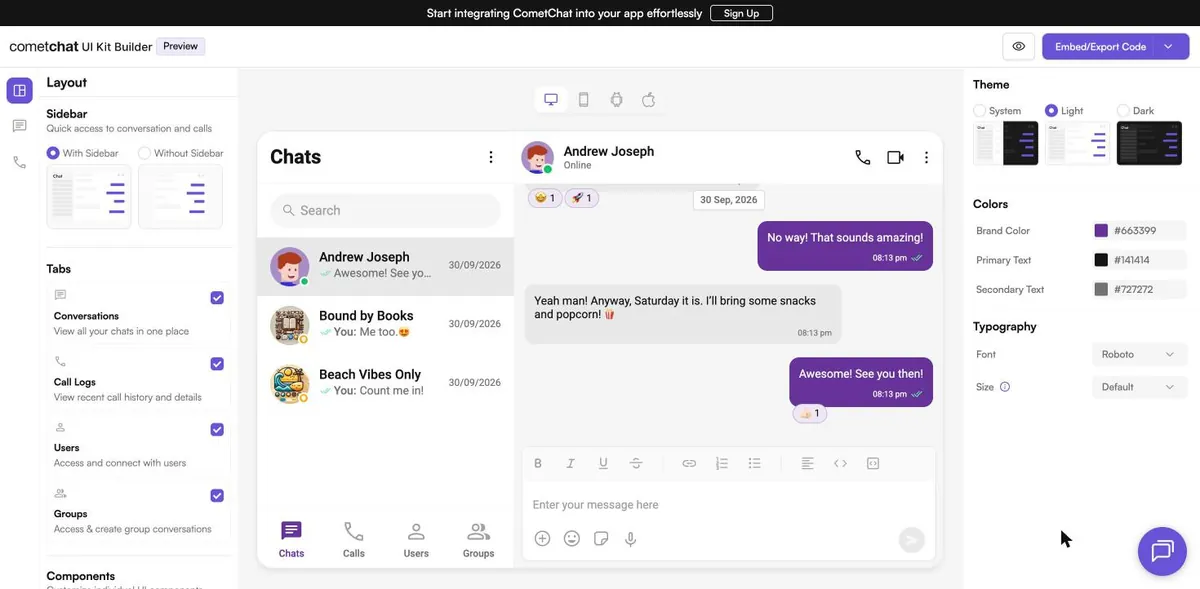
- The builder opened without an account on a demo chat (Chats, Calls, Users, Groups) with sample conversations. Customize offers a layout with or without sidebar (default with) and the tabs Conversations, Call Logs, Users and Groups, all on by default.
- Setting the brand colour to #663399 with the colour picker recoloured our own chat bubbles at once. In Dark the brand colour stayed; the primary and secondary text colours switched automatically (#FFFFFF and #989898, against #141414 and #727272 in Light).
- Exporting is not possible from the preview. Embed/Export Code offers React, Angular and no-code targets (WordPress, HTML, PHP, Laravel, Shopify, Webflow, Wix, Squarespace and others), but choosing one shows 'Sign in to get your Embed Code': sign in or create an account, create an app in the dashboard, open the Chat Builder there and export. The preview settings do not come along, so the configuration has to be made again.
Pricing (2026)
✓ Pricing re-verified 7 Oct 2026
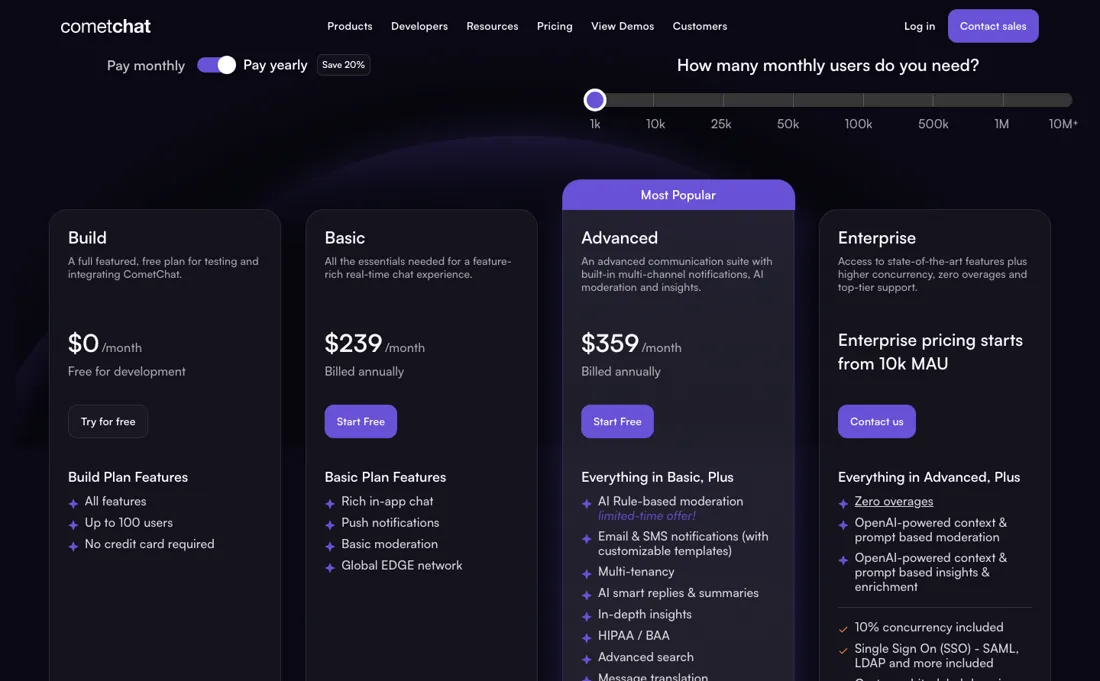
Build is free for development: all features, up to 100 users and 25 concurrent connections, no card. Paid Chat plans are priced by monthly active users. Billed yearly, shown as a monthly equivalent: at 1,000 MAU Basic is $239 and Advanced $359; at 10,000 MAU Basic $299, Advanced $399 and Enterprise $999; at 25,000 MAU $699 and $949; at 50,000 MAU $1,349 and $1,649.
Paying monthly costs 25% more — $298.75 and $448.75 at 1,000 MAU; the 'Save 20%' on the toggle is the same gap measured from the monthly price. Above 50,000 MAU everything is quote-only. Concurrency is included at 5% of your MAU on Basic and Advanced and 10% on Enterprise. On overage CometChat charges $0.10 per extra MAU (falling at higher tiers) or $1 per extra concurrent connection — and where both are exceeded it bills the higher of the two, not both.
Enterprise has no listed overage; usage above the plan is upgraded to the appropriate plan instead. Messages and storage are unlimited on every plan, and message retention is 6 months across the board, extendable at extra cost. Plans change — always verify the live price on their site.
Category context: Communication & Voice. Across the 22 tools in this category that we researched with a public US-dollar price, the median entry price is about $30 a month (lowest paid plan as listed, per seat where the vendor prices per seat). CometChat’s entry price of $239 a month sits above that median. Compare pricing conditions in the Software Cost Atlas →
Correction after re-checking: Chat & Messaging list prices are published rather than quote-only: at 1,000 MAU, Basic is $239/month and Advanced $359/month on yearly billing ($298.75 and $448.75 on monthly billing). Those rise to $1,349 and $1,649 per month at 50,000 MAU on yearly billing, and Enterprise starts from 10,000 MAU at $999/month yearly. Only 100,000 MAU and above is "Get in touch". Overages are $0.10 per MAU and $1 per concurrent connection, and when both allowances are exceeded CometChat bills the higher of the two, not both. (re-verified 2026-07-31)
What the price did
We capture CometChat’s own pricing page every month and keep the figures, so this is our record of the page — not a forecast, and not someone else’s summary.
The overage rates are the part of CometChat's pricing that has stayed put: $0.10 per monthly active user and $1 per concurrent connection appear identically in our July and August 2026 captures and again in the machine-readable reference we read on 17 August 2026. What changed in that window is disclosure rather than price — the plan ladder that used to sit behind a slider is now published as a full MAU-by-tier table, which is why this page can quote figures earlier reviews could not.
What the pricing page doesn’t say
Model your MAU growth curve and the overage math before you architect around it. Chat infrastructure is sticky by nature; the time to compare vendors is before launch, not after.
Watch the video review
The video version of this review, from our YouTube channel.
⚡ Short on time? Watch the 30-second verdict Short.
What CometChat does
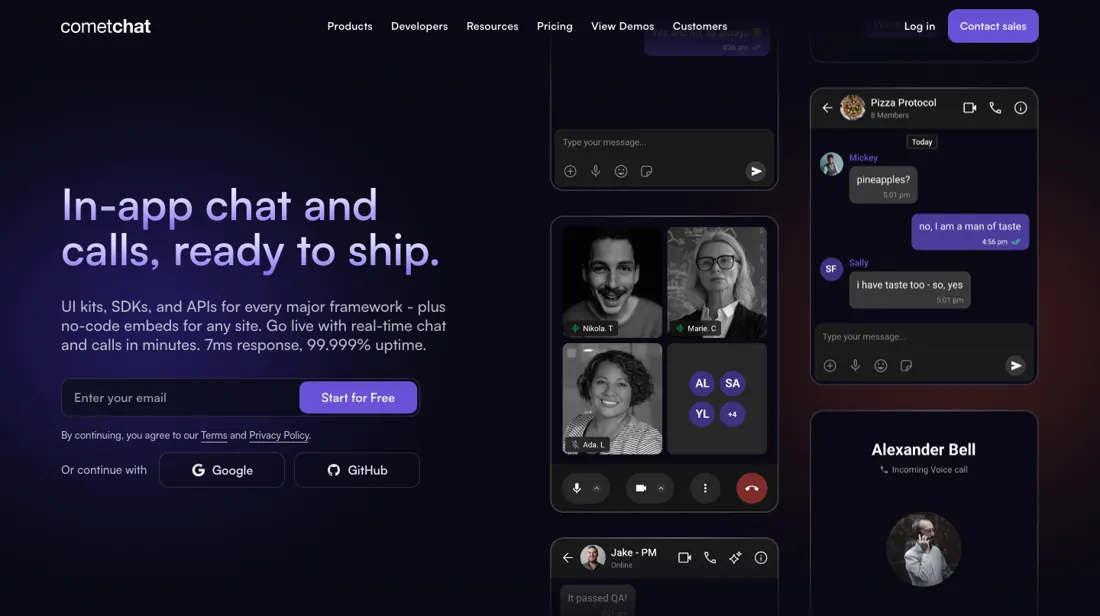
In-app text, voice and video chat infrastructure to embed into your own software — secure and scalable, with a free developer plan and, via the new Air release, fully on-prem or air-gapped deployment for regulated enterprises.
What buyers report about CometChat
Hands-on: tested 2026-10-23Reported by buyers: G2, Trustpilot and developer write-ups, read August 2026
Themes from the buyer-review sites listed at the foot of this page, read in August 2026. We tested CometChat ourselves on 2026-10-23, but one test is a narrow sample, so here is what other buyers report. We summarise it here because the complaints are usually the part a vendor page leaves out.
- • Developers rate the API highly — WebSockets and webhooks that behave, pre-built UI kits, SDKs across languages and documentation that holds up. Around 4.6 on G2 across 110 reviews.
- • Support replies in 20 to 30 minutes, which reviewers name specifically.
- • Monthly active users above your tier are billed at $0.10 each with no hard cap and no alerting. One reviewer was charged over $2,000 before their product had even launched; a COO watched the bill rise fivefold. Set your own monitoring — the platform will not warn you.
- • There is nothing between the 100-MAU free tier and the first paid plan at 1,000 MAU, which third-party sources put at roughly $239-$299 a month.
- • Reviewers found pricing behind a slider rather than a published table. That has changed: CometChat now publishes the full MAU ladder (read 7 October 2026) on its pricing page and in pricing.md.
- • The interface needs work by reviewers' account, and adapting it costs development time.
Pages read (August 2026): Trustpilot
When the paid plan is worth it
CometChat's Build plan is free and includes up to 100 users and 25 concurrent connections, with 10,000 voice and video minutes to test; the vendor's FAQ says you must subscribe to a paid plan to go live. At 1,000 MAU, Basic is $239/month on yearly billing ($298.75 monthly) and Advanced $359/month yearly ($448.75 monthly). CometChat's own plan comparison marks Basic "No" for message translation and AI powered moderation, where Build and Advanced read a bare "Yes".
Basic is also "No" for conversation search, email and SMS notifications, but the yes there is qualified: search reads "Yes (Indexing of your latest messages, up to 25 times your MAU)" on Advanced, 50 times on Enterprise. Email needs an active SendGrid account and SMS an active Twilio account. Multi-tenancy, user and group insights and HIPAA with BAA are missing from Basic too. Upgrading does not fix three things. Message retention stays 6 months on every Chat plan, extendable only at additional cost; the AI Copilot rows need your own OpenAI subscription; and the 99.999% uptime SLA, custom white-label domain and on-premise deployment stay paid add-ons, the last on Enterprise only.
What we found running CometChat ourselves
The first findings are at the top of this page. The rest:
- Chat Features has about 20 switches (among them typing indicator, photo, video, audio and files, editing, deleting, delivery and read receipts, presence, threads, quoted replies, pin, AI user copilot and moderation). With read receipts off, the double ticks disappeared from the bubbles and the conversation list, and came back when switched on. The typing indicator cannot be checked in a static preview.
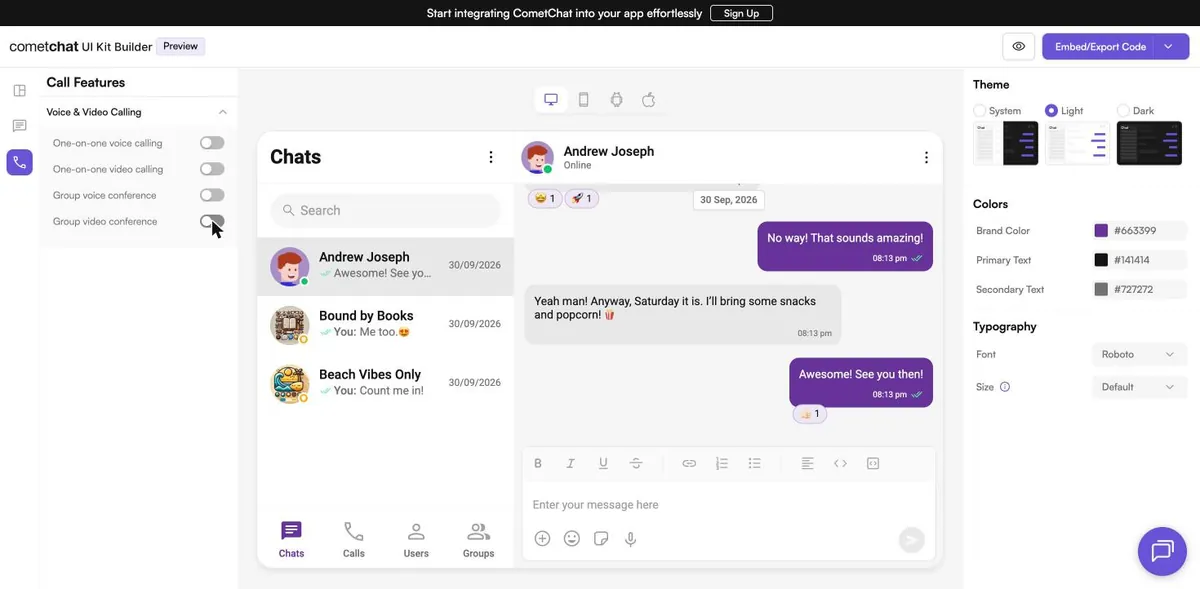
- Turning off all four call switches (one-on-one voice and video, group voice and video conference) removed the call and video buttons from the chat header. The Calls tab at the bottom stayed: it belongs to the separate Call Logs layout setting.
Screenshots from our test (click to enlarge)
What this test does not show:
- The exported code and whether it carries the settings (export needs an account and an app)
- Real message delivery, syncing, SDK integration and your own backend
- MAU billing and the 100-user limit on Build
- The mobile kits (the Android and iOS views were only seen as a switch)
Most of our reviews are researched rather than run — how we review explains which is which, and why we do not pretend otherwise.
Questions we are still checking
Facts about CometChat that would change a buying decision, and where we stand on each. An unanswered question does not mean the feature is missing; it means we have not confirmed it yet.
- Is there a bulk export of message history when you leave CometChat? Still checking
Applies to: all Chat plans; messages are readable through the APIs for 6 months.
Why it matters: without an exit export, anything older than the retention window or not copied out in time is lost when you switch vendor.
Checked: CometChat pricing reference (pricing.md) (2026-10-07); CometChat documentation index (llms.txt) (2026-10-07)
Have a public source that answers one of these? How we review explains how we check and correct.
How to actually use CometChat
The vendor's React guide summarises the route as "Add CometChat to a React.js app in 4 steps: create project, install, init + login, render"; App ID, Auth Key and Region are prerequisites, not a step. The install command pulls @cometchat/chat-uikit-react, @cometchat/chat-sdk-javascript and dompurify. Node.js 18+ and React 18+ are required, and CometChat ships pre-created test UIDs (cometchat-uid-1 through cometchat-uid-5), so a two-panel chat runs before any signup flow exists. The guide's quick reference warns that breaking the init() to login() to render order gives a blank screen.
The troubleshooting page adds that CometChatProvider relies on WebSocket connections, window and localStorage, so Next.js, Remix and Astro raise hydration mismatches unless that boundary is client-only. It also notes that custom hooks attaching SDK listeners leave duplicate listeners during development under StrictMode unless they return a cleanup function. All v7 hooks handle cleanup automatically. Auth Key is development-only; production needs server-generated Auth Tokens via the REST API. The repository has two open issues: the composer freezing on pasted long formatted text (#106, 3 April 2026) and rich text breaking links (#107, 8 April 2026).
Where this section comes from: our research notes (144 words)
CometChat pricing page, opened live in this session (https://www.cometchat.com/pricing, read 2026-07-31); CometChat's own machine-readable pricing file, which carries the monthly and yearly MAU price ladders, the usage and overage notes, the FAQ and the full plan comparison table (https://www.cometchat.com/pricing.md, read 2026-07-31); CometChat React UI Kit integration guide (https://www.cometchat.com/docs/ui-kit/react/integration-react.md, read 2026-07-31); CometChat React UI Kit troubleshooting page (https://www.cometchat.com/docs/ui-kit/react/troubleshooting.md, read 2026-07-31); public issue tracker of the official React UI Kit repository (https://github.com/cometchat/cometchat-uikit-react/issues, read 2026-07-31).
All pricing and feature-tier statements come from CometChat's own pages; the GitHub issues are public user reports, not independent reviews. Re-verified 7 October 2026: https://www.cometchat.com/pricing.md (still marked last verified 2026-05-20 by CometChat) and the live pricing page in a browser render (same yearly MAU ladder, overage rates, 6-month retention and FAQ); the documentation index https://www.cometchat.com/docs/llms.txt and the REST API rate-limit page https://www.cometchat.com/docs/articles/rate-limits.md. The documentation index lists no billing, cancellation or data-export article.
The natural comparison is Stream or Sendbird — the premium chat-SDK peers — all three are MAU-priced; compare at YOUR projected MAU including overages, not at the entry tier.
Frequently asked questions
What does CometChat cost at my user count?
It is priced per monthly active user, so the answer moves with your scale. Billed yearly, at 1,000 MAU Basic is $239 a month and Advanced $359; at 10,000 those are $299 and $399, with Enterprise entering at $999; at 25,000 they are $699 and $949; at 50,000 $1,349 and $1,649. Monthly billing costs 25% more. Read on 17 August 2026 from CometChat's own machine-readable pricing reference and again on 7 October 2026 on the live pricing page, unchanged.
Can an overage surprise me the way earlier reviewers describe?
The mechanism is real but narrower than it is often described. Included concurrency is 5% of your MAU on Basic and Advanced, and beyond your allowance CometChat charges $0.10 per extra monthly active user or $1 per extra concurrent connection — and when both are exceeded it bills the higher of the two rather than adding them together. Enterprise carries no listed overage at all; usage above the plan triggers an upgrade instead. There is still no hard cap on Basic and Advanced, so set your own alerting.
How does it compare with Twilio for chat?
The comparison people actually search for, and the split is in the pricing model rather than the feature list. CometChat charges for the users who show up (per MAU, with unlimited messages and storage on every plan, and 6 months of message retention) while Twilio's conversational products meter the traffic itself. If your users are chatty, a per-MAU plan with unlimited messages is predictable in the way per-message billing is not; if you have a large but quiet user base, the same structure works against you.
Who counts as a monthly active user, and when do I have to start paying?
Anyone who connects. CometChat's FAQ defines a monthly active user as a user that has connected to CometChat servers during the subscription period, so someone who opens your app once in the month counts the same as a daily user. Peak concurrent connections are the most devices connected at the same time; for multi-tenant subscriptions they are measured per app, aggregated by day, and the highest day of the month is used. The free Build plan covers up to 100 users and 25 concurrent connections for development and testing, but the FAQ says you must subscribe to a paid plan when you go live. Multi-tenancy itself is an Advanced and Enterprise feature. Read on the pricing page and in pricing.md, 7 October 2026.
How long are messages kept, and what can I take with me?
Messages can be read through the APIs and SDKs for 6 months on every Chat plan, Enterprise included; a longer retention window is a paid extension. Images and files are stored without a time limit. Neither the pricing page nor the documentation index we read on 7 October 2026 describes a bulk export of message history when you leave, so plan to copy what you must keep inside the retention window, through the REST API or the messaging webhooks that every plan includes. An exit export is not confirmed.
Is this a hands-on review of CometChat?
Yes. We tested CometChat ourselves on 2026-10-23; the section above says what we tested, what we found and what we did not test, and where a figure comes from the vendor's own documentation instead. Most of our reviews are researched rather than run; we say which is which. We name what each tool is good and bad at, and we earn a commission only if you sign up, at no cost to you.
- Buyer reviews on G2, Trustpilot and developer write-ups, read August 2026.
- Re-verified 2026-08-17 and 2026-10-07 against CometChat's own machine-readable pricing reference, which they publish for AI agents and last verified themselves on 2026-05-20, and on 2026-10-07 also against the live pricing page; USD.
- A dated screenshot of that pricing page, kept on this site as the receipt.
- Our own hands-on session with CometChat (2026-10-23), written up in full further down this page.
Others in this category
Reviewed communication & voice tools that share ground with CometChat — comparable in what they do, not drop-in swaps:
New reviews, price changes we recorded, and the cost conditions we found. No sponsored placements. Unsubscribe anytime.
This is our researched assessment — not a paid placement. The “Visit” links on this page are affiliate links: we may earn a commission if you sign up, at no extra cost to you, and it never changes our take. How we review →