Signal House Review (2026)500 Numbers Cost Less Than 499
 By Daan Haket · Researched and written with an AI assistant · who does what
The first is voice.
teams sending real SMS volume in the US who already know what an A2P 10DLC campaign is and want a cheaper per-segment rate than Twilio’s list without giving up published pricing. The volume ladder is genuinely steep — from $0.0065 down to $0.0030 — so the case gets stronger the more you send, and the number discounts above 500 numbers suit anyone running many local presences.
you are mainly buying voice, because there is no published rate to compare and no way to model the cost. Skip it too if your volume is small: at a few thousand messages a month the per-segment saving against Twilio is a few dollars, and you would be trading a mature ecosystem and documentation for that. And if you are not already registered for A2P 10DLC, budget the brand and campaign fees plus the approval wait before you compare anything — those apply wherever you send from.
Transparency: the “Visit” links on this page are affiliate links — we may earn a commission if you sign up, at no extra cost to you. No vendor can pay for a better review or verdict. How we make money →
Pricing (2026)
✓ Pricing re-verified 13 Oct 2026
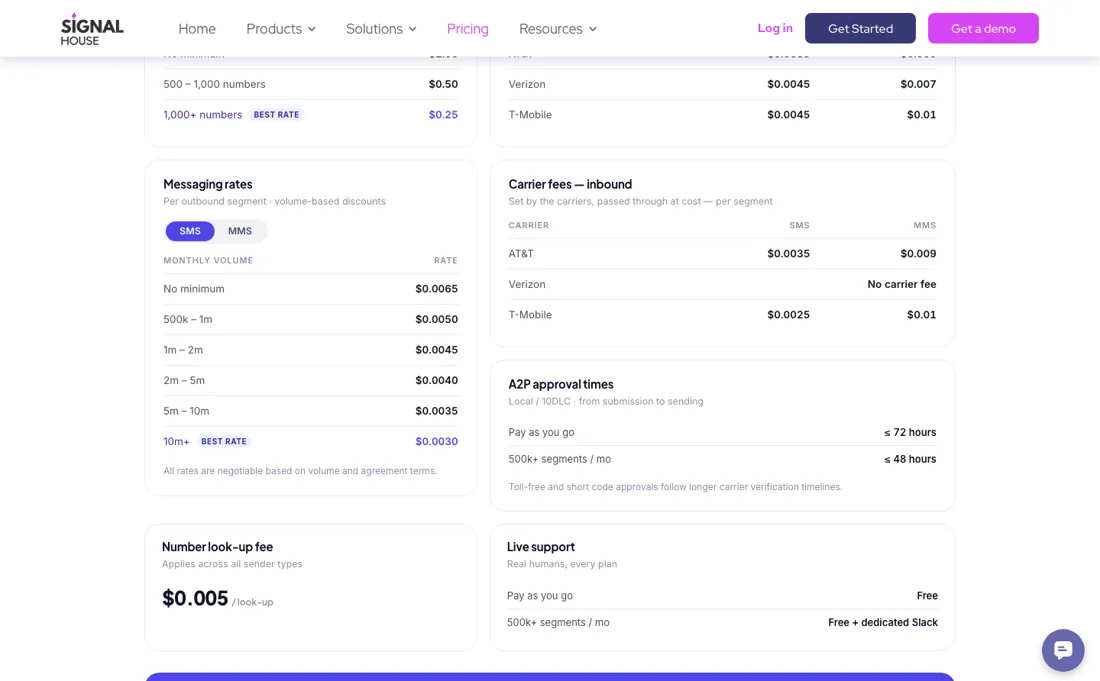
(2026-09-11, re-read on their own pricing page and again on 13 October 2026) Usage-based, no platform subscription. SMS on a 10DLC local number costs $0.0065 per segment with no minimum, falling on volume: $0.0050 from 500k segments a month, $0.0045 from 1m, $0.0040 from 2m, $0.0035 from 5m and $0.0030 from 10m. Numbers are $1.00 a month, dropping to $0.50 between 500 and 1,000 numbers and $0.25 above 1,000.
MMS is $0.0200 per segment, $0.0170 above 500k. Toll-free numbers are $1.00 a month with SMS from $0.0079 down to $0.0050. Number lookup is $0.005. A2P 10DLC registration is billed separately: $4.50 for the brand, $15 one-time per campaign, then $1.50 a month for a low-volume campaign or $10 a month for a standard one. Carrier fees are passed through on top and are published per carrier for both directions: outbound SMS is AT&T $0.0035, Verizon $0.0045, T-Mobile $0.0045 and US Cellular $0.0025, while outbound MMS costs two to three times as much — AT&T $0.009, Verizon $0.007, T-Mobile $0.01, US Cellular $0.005.
Full pricing notes (2 more paragraphs)
Inbound SMS is AT&T $0.0035, T-Mobile $0.0025, US Cellular $0.0025 and free on Verizon. A2P approval is quoted at 72 hours or less, dropping to 48 hours above 500k segments a month. Every rate table carries the note that all rates are negotiable on volume and agreement terms. Short code is now priced on the same page (13 October 2026): $1,000 one-time setup and $500 for MMS enablement, then $1,000 a month ($11,000 a year paid upfront) for a random code, $1,500 ($16,500) for a vanity code or $500 ($5,500) for a customer self-leased code, with short code SMS on the same ladder as 10DLC from $0.0065 down to $0.0030 and MMS at $0.0200, $0.015 above 500k.
Voice is now presented on the home page as a live product (programmable calling, WebRTC softphones, SIP trunking and call analytics) but still has no published rate, and the site's Coming Soon list now names WhatsApp, Salesforce, Medusa, RCS, Alphanumeric and Apple Business.
Plans change — always verify the live price on their site.
Category context: Communication & Voice. Across the 22 tools in this category that we researched with a public US-dollar price, the median entry price is about $30 a month (lowest paid plan as listed, per seat where the vendor prices per seat). Compare pricing conditions in the Software Cost Atlas →
Vendor-confirmed: Stated on Signal House's own offer page and confirmed in writing, 19 Oct 2026. Not tested by us at a checkout.
What the pricing page doesn’t say
The product is sold as an SMS and Voice API and the pricing page publishes no voice rate at all (short code pricing was added by 13 October 2026; voice still has none). If the voice half is why you are looking, you cannot budget it from public information and will have to ask. The second is the arithmetic behind the Twilio comparison, which is the whole pitch. Take the entry rate with no minimum.
Signal House is $0.0065 a segment against Twilio’s $0.0083, which reads as a 22% saving. But carrier fees are a pass-through and identical either way: add T-Mobile’s $0.0045 to both and you get $0.0110 against $0.0128 — about 14%, not 22%. Numbers narrow it further, $1.00 against $1.15. So the saving is real and it is worth having at volume, but it is a discount on the platform margin rather than on your bill, and the headline does not make that distinction.
On a million segments a month that difference is roughly $1,800 a month against Twilio’s list — worth switching for, provided the voice side does not turn out to be where the money goes. Worth noting on the other side: Signal House prints its A2P 10DLC registration fees on the pricing page, and Twilio’s equivalent page says only that fees apply and points elsewhere. Being able to see the whole bill before you sign is not nothing.
Watch the video review
The video version of this review, from our YouTube channel.
⚡ Short on time? Watch the 30-second verdict Short.
What Signal House does
SMS and Voice API positioned as a Twilio alternative. A2P 10DLC fees are published; voice rates are not.
What buyers report about Signal House
Hands-on: not tested by usReported by buyers: G2, read August 2026
Themes from the buyer-review sites listed at the foot of this page, read in August 2026. We have not run Signal House ourselves, so this is other buyers' experience rather than ours. We summarise it here because the complaints are usually the part a vendor page leaves out.
- • A2P 10DLC registration is what buyers actually credit, and they quote times: approval on the first attempt in under 24 hours (US, August 2026) after repeated rejections elsewhere, and a campaign live in about two days with documentation the reviewer found clear enough to follow without guesswork (US, August 2026).
- • GoHighLevel agencies are the loudest group in the record. One mid-market owner (August 2026) moved roughly 140 client accounts across, runs day-to-day contact through a dedicated Slack channel, and values seeing real deliverability from upstream carriers rather than GHL's native path.
- • Support is free and staffed by people who know messaging, and reviewers contrast that explicitly with being steered toward paid help elsewhere: several name the individuals who walked them through brand registration and number configuration.
- • Developers report the newer API and its webhook model are a genuine improvement, with documentation described as much better than the previous generation (July 2026).
- • The lowest-rated review (US, November 2025) is a list of operational failures worth reading in full before you switch: campaign verification that took nine days per campaign instead of the promised window, top-ups capped at $100 with no auto-recharge, no alert when the balance ran out so messages failed silently, and an outage at their downstream carrier partner that left messages undelivered while billing continued. Signal House replied publicly, attributed the outage to that partner, said their contract requires a 48-hour campaign review, and said auto-recharge was about to ship.
- • An insurance company reviewer (April 2026) reports past billing problems and asks for a real ticketing and record-keeping system rather than ad-hoc support threads.
- • Small undocumented rules keep surfacing: a $30 minimum wallet balance before you can submit, mentioned nowhere until you hit it (August 2026), and GoHighLevel-specific setup steps that reviewers would rather read than ask about — support answers fast, but the written docs lag the product.
Where the ratings disagree. 185 reviews averaging 4.8, and the shape is lopsided: 167 at five stars, two below four. But look at who is writing before you weigh that. The record is dominated by small businesses and GoHighLevel agencies buying SMS with hands-on onboarding, so it is strong evidence about A2P approval speed and about support, and no evidence at all about the voice half of the product — not one reviewer mentions voice, and the vendor publishes no voice rate either.
Number 500 makes your bill drop by $249
There is no platform subscription here at all — everything is usage-based, and the page is unusually specific about it (2026-08-07, read on their own pricing page). SMS on a 10DLC local number is $0.0065 a segment with no minimum, falling to $0.0050 from 500k segments a month, $0.0045 from 1m, $0.0040 from 2m, $0.0035 from 5m and $0.0030 from 10m. MMS is $0.0200, or $0.0170 above 500k. Numbers are $1.00 a month, $0.50 between 500 and 1,000, and $0.25 above 1,000.
Lookup is $0.005. That numbers ladder contains something worth catching, because both breaks are applied to the whole estate rather than to the numbers above the threshold. At 499 numbers you pay $499 a month. At 500 you pay $250. Adding one number reduces your bill by $249 — and the same thing happens again at 1,000, where 999 numbers cost $499.50 and 1,000 cost $250. If you are anywhere near either line, and outbound SMS at scale means rotating numbers, this is free money for the asking.
The saving against Twilio that headlines the pitch is real but a good deal narrower than advertised once carrier fees go on both sides of the sum, and the knock takes that apart. What belongs here is what happens to whatever gap survives as you scale, because it gets structurally smaller as you grow, which is the opposite of what procurement instinct expects. At the entry rate the carrier fee is 41% of your all-in cost per segment.
At 10 million segments a month, where Signal House charges $0.0030, the same unchanged carrier fee is 60% of it. The higher your volume, the smaller the share of your bill any vendor choice can move. Two more things. MMS barely benefits from volume: it is 3.1 times the SMS rate at entry and has a single 15% break, against SMS's five steps down to a 54% reduction — so a picture-heavy programme should be costed separately rather than assumed to scale.
And A2P 10DLC registration is billed apart: $4.50 for the brand, $15 once per campaign, then $1.50 a month for a low-volume campaign or $10 for a standard one. Signal House prints those on the pricing page; Twilio's equivalent page says only that fees apply and points elsewhere. Seeing the whole bill before you sign is not nothing. The gap is voice. The home page now presents it as a live product — programmable calling, WebRTC softphones, SIP trunking — but the pricing page still prints no voice rate (re-read 13 October 2026), and no volume tier changes that: reaching a cheaper SMS break does nothing to make the voice half budgetable.
Every rate table also closes by calling all rates negotiable, making the ladder an opening position rather than a tariff.
How to actually use Signal House
Register your A2P 10DLC brand and campaign first, because nothing sends until that clears and it is billed apart from everything else: $4.50 for the brand, $15 once per campaign, then $1.50 a month for a low-volume campaign or $10 for a standard one. Approval is quoted at 72 hours or less, so start it before you build. Model your cost per segment all-in rather than from the platform rate.
Add the carrier pass-through — AT&T $0.0035, Verizon $0.0045, T-Mobile $0.0045 — to whatever tier your volume reaches, because that is the number that goes on your invoice and it is the number any competitor comparison has to use too. Count your numbers before you provision them. The volume breaks apply to the whole estate, so 500 numbers cost $250 while 499 cost $499, and 1,000 cost $250 while 999 cost $499.50.
If you are near either line, cross it. And if you need voice, get a written rate before you plan around it: the site now presents voice as a live product, but the pricing page publishes no voice rate (re-read 13 October 2026). Short code, by contrast, is now priced — $1,000 setup plus $500 a month for a self-leased code or $1,000 for a random one — so it can be budgeted.
Where this section comes from: our research notes (175 words)
Signal House's own pricing page, signalhouse.io/pricing/, re-read on 11 September 2026: the usage-based SMS rates with their volume breaks ($0.0065 per segment on a 10DLC local number, falling to $0.0050, $0.0045, $0.0040, $0.0035 and $0.0030), the number pricing ($1.00, $0.50 from 500 numbers, $0.25 above 1,000), the carrier pass-through tables for outbound and inbound SMS and MMS across AT&T, Verizon, T-Mobile and US Cellular, and the A2P 10DLC registration fees — $4.50 for the brand, $15 once per campaign and then $1.50 a month for a low-volume campaign or $10 for a standard one.
Re-read on 13 October 2026: the pricing page now publishes short code fees and rates but still no voice rate, and the home page (signalhouse.io) presents Voice and Short Code as current products, with a Coming Soon list naming WhatsApp, Salesforce, Medusa, RCS, Alphanumeric and Apple Business instead; that is why the review says the voice half cannot be budgeted from what is public. Wallet and auto-recharge mechanics come from Signal House's help article 'Billing Settings' (help.signalhouse.io/en/articles/5778881), read 13 October 2026.
The natural comparison is Twilio — the comparison Signal House invites, and it is checkable. On the entry tier Signal House charges $0.0065 a segment against Twilio’s $0.0083, and $1.00 a month for a local number against $1.15. Carrier fees are pass-through and the same on both, so the all-in gap is nearer 14% than the 22% the message rate alone suggests. What Twilio has that does not show up in a rate table is depth: a far larger ecosystem, more documentation and a longer track record, plus voice pricing you can actually read. Both price lists here were read on 2026-08-07 — verify them yourself, because usage-based rates move and neither vendor publishes every fee in one place..
Frequently asked questions
Is it prepaid, and what happens if my balance runs out?
It is a prepaid wallet. Signal House's help article 'Billing Settings' (help.signalhouse.io, read 13 October 2026) says you add funds under Settings > Billing and they appear in the wallet balance once the card clears; ACH is not supported yet. Its FAQ warns that when the balance runs out, campaigns may pause or fail to deliver messages, and recommends auto-recharge, where you set a minimum balance of at least $30, a top-up amount, a primary card and a backup card.
Can I move my existing numbers and campaigns from Twilio?
The pricing page FAQ (read 13 October 2026) says Signal House supports single and bulk porting for 10DLC and toll-free numbers, and that its carrier and aggregator relationships allow existing campaigns to be migrated without interruption. That no-downtime claim is the vendor's own statement; it is not something the page documents step by step.
Is this a hands-on review of Signal House?
This is a researched assessment, not a hands-on test — where we've used a tool ourselves, we say so explicitly. We name what each tool is good and bad at, and we earn a commission only if you sign up, at no cost to you.
- Buyer reviews on G2, read August 2026.
- 2026-09-11, re-read on their own pricing page and again on 13 October 2026.
- A dated screenshot of that pricing page, kept on this site as the receipt.
Others in this category
Reviewed communication & voice tools that share ground with Signal House — comparable in what they do, not drop-in swaps:
New reviews, price changes we recorded, and the cost conditions we found. No sponsored placements. Unsubscribe anytime.
This is our researched assessment — not a paid placement. The “Visit” links on this page are affiliate links: we may earn a commission if you sign up, at no extra cost to you, and it never changes our take. How we review →