Ruby Review (2026)
 By Daan Haket · Researched and written with an AI assistant · who does what
You're paying premium rates for real human receptionists billed per minute — worth it when a missed call is a lost client, but expensive if your call volume is low or an AI answering service would do the job for a fraction.
client-driven service businesses (law, home services, clinics) where a live human answering every call directly wins business.
your call volume is low or mostly routine — an AI answering service or a solid voicemail-to-text setup costs far less.
Transparency: we earn nothing from Ruby; the links to it are plain links. How we make money →
Pricing (2026)
✓ Pricing re-verified 6 Oct 2026
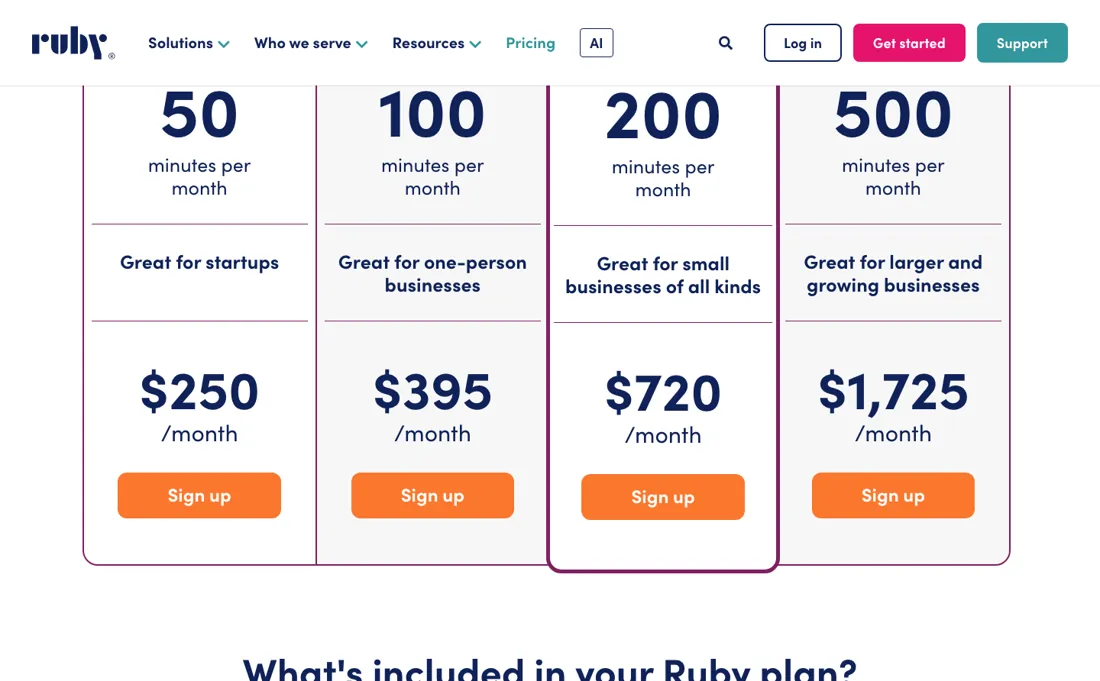
Read on their own plans-and-pricing page, 6 September 2026, and unchanged on 6 October 2026. Virtual receptionist plans are sold by monthly minutes: 50 minutes $250, 100 minutes $395, 200 minutes $720, 500 minutes $1,725 — $5.00 a minute at the bottom, $3.45 at the top. Live chat is sold by monthly chats: 10 chats $143, 30 chats $335, 50 chats $520.
Add chat to a receptionist plan and those become $115, $268 and $416 — the 20% the page advertises, exact at the two larger tiers and rounded up from $114.40 at the smallest. Larger volumes are quoted. Ruby states there are no extra fees for activation, onboarding, setup, customisation or out-of-hours coverage, and every feature is included at every tier — the plans differ only in the number of minutes or chats. No rate is published for minutes used beyond your plan. Plans change — always verify the live price on their site.
Category context: Communication & Voice. Across the 22 tools in this category that we researched with a public US-dollar price, the median entry price is about $30 a month (lowest paid plan as listed, per seat where the vendor prices per seat). Ruby’s entry price of $250 a month sits above that median. Compare pricing conditions in the Software Cost Atlas →
Correction after re-checking: Receptionist plans are billed monthly on included minutes: $250/mo for 50 minutes, $395/mo for 100 minutes, $720/mo for 200 minutes and $1,725/mo for 500 minutes, with larger volumes quoted on request. Standalone live chat runs $143/mo for 10 chats, $335/mo for 30 chats and $520/mo for 50 chats; adding chat to a receptionist plan costs $115, $268 or $416/mo at those same chat volumes, which Ruby describes as a 20% saving. Minutes are billed in 60-second increments rounded up, and extra minutes or chats bill at the plan's overage rate (rate not published). Ruby states there are no activation, onboarding, setup or customization fees. There is no free tier and no annual-billing toggle; first-time buyers get a money-back window that closes at 21 days, or at 500 receptionist minutes / 50 billable chats, whichever comes sooner. (re-verified 2026-08-13)
What the price did
We capture Ruby’s own pricing page every month and keep the figures, so this is our record of the page — not a forecast, and not someone else’s summary.
We captured ruby.com's plans-and-pricing page on 7 July and 2 August 2026 and read it again by hand on 13 August 2026. Every amount is identical in all three: $250, $395, $720 and $1,725 a month for 50, 100, 200 and 500 receptionist minutes; $143, $335 and $520 for standalone chat; $115, $268 and $416 for chat bundled with a receptionist plan. Reviewers elsewhere describe repeated price rises, so this is worth saying precisely: over the five weeks we have measured, the list price has not moved.
Ruby’s pricing page, as we read it
Watch the video review
The video version of this review, from our YouTube channel.
⚡ Short on time? Watch the 30-second verdict Short.
What Ruby does
Live human receptionists answering your calls, plus chat. Premium rates that pay off only when a missed call is a lost client.
What buyers report about Ruby
Hands-on: not tested by usReported by buyers: G2, Capterra, Software Advice and the Apple App Store, read August 2026 (App Store reviews read 13 August 2026)
Themes from the buyer-review sites listed at the foot of this page, read in August 2026 (App Store reviews read 13 August 2026). We have not run Ruby ourselves, so this is other buyers' experience rather than ours. We summarise it here because the complaints are usually the part a vendor page leaves out.
- • Receptionists sound like your company rather than an answering service — professionalism and friendliness are the consistent praise. Around 4.6 on G2.
- • Callers get a person, and reviewers report measurably better call handling because of it.
- • Per-minute billing with no overage warning is the complaint that hurts. One reviewer's bill went from $660 to $5,100 with no explanation offered.
- • Minutes are not just talk time — hold time and the receptionist's work around the call draw from your allotment. Hangups have been billed at 30 seconds.
- • Plans run $250 for 50 minutes to $1,725 for 500. At the entry tier that is $5.00 a minute.
- • Repeat price increases, and reviewers describe service quality slipping while the price rose.
- • The Ruby 2.0 app carries its own complaint pile in the Apple App Store, separate from the service: seven of the twelve reviews there are one star, and the 2023 migration is the theme — reviewers describe the switch arriving with no notice, a password reset that could not be completed, and the option to send an outgoing text from their toll-free number disappearing in the new version.
- • A September 2025 App Store reviewer describes the app as slow and effectively unmaintained: messages lagging, call logs slow to load, push notifications failing and no meaningful update in over a year.
- • One App Store reviewer reports duplicated charges for the same call — the same nerve as the per-minute billing complaints elsewhere, seen from the invoice rather than the plan.
Where the ratings disagree. Around 4.6 on G2 and Capterra against an App Store listing where most reviews are one star. They are not rating the same thing: the software directories rate the receptionists — the humans answering the phone, which is what people praise — while the App Store rates the Ruby 2.0 app introduced in 2023, and those reviews are dominated by the migration and by billing. Both can be true at once. Which one should weigh more depends on whether your team lives in the app or only in the call.
When the paid plan is worth it
Ruby's ladder buys minutes, not features: $250 for 50 receptionist minutes, $395 for 100, $720 for 200 and $1,725 for 500, all read on their plans-and-pricing page again on 19 August 2026. What climbing it actually buys is a lower rate per minute -- $5.00 at the entry plan, then $3.95, $3.60 and $3.45 at 500 minutes. Every plan carries the same live receptionists and the same app, so the tier is a volume decision rather than a capability one.
What upgrading does not solve is the meter. Ruby bills receptionist minutes in 60-second increments and rounds each call up to the nearest 60-second mark, so a run of twenty-second calls costs a full minute apiece on the $1,725 plan exactly as it does on the $250 one. No tier carries an annual-billing discount to soften that. The overage rate is not published either: the FAQs say only that additional minutes bill at the overage rate associated with your plan, so the cost of guessing your volume wrong is a number you cannot look up before you sign.
Our monthly capture read this vendor's pricing page every month from July 2026 to October 2026, and the amounts were the same all 4 times, including $416, $520, $720 and $1,725 from the pricing above. We keep watching — the registry records what moves.
How to actually use Ruby
Value only arrives once live calls actually reach Ruby, so call forwarding is the opening job. Ruby documents two options. One is forwarding a business number hosted by an outside phone provider, which its onboarding team helps initiate with most providers. The other is letting Ruby host the number, so forwarding is managed from the app and portal. Ahead of that, an Onboarding Specialist walks through normal call handling instructions: what receptionists should do when the owner is available and when they are not.
Daily use then lives at my.call-ruby.com or the iOS and Android app, where the Activity section holds messages that also arrive by email and text. The common snag is meter awareness rather than setup. Ruby bills receptionist minutes in 60-second increments and rounds calls up to the nearest 60-second mark, so brief calls still cost a full minute. The app raises an alert at 85% of plan minutes and again at 100%, and the money-back window closes at 21 days or 500 receptionist minutes, whichever comes sooner.
Where this section comes from: our research notes (98 words)
The minute and chat tiers, the bundled-chat prices and the inclusive-pricing statement read on ruby.com/plans-and-pricing on 6 September 2026. The tiers sit in a 'Build your plan' widget rather than a static table, which is why an earlier attempt could not confirm them; the per-minute rates and the check on the advertised 20% bundle discount are our own arithmetic on the published figures. Re-verified 6 October 2026 on ruby.com/plans-and-pricing (every minute and chat tier unchanged).
The minute and chat counting rules, cancellation, number portability, minute pooling and HIPAA answers come from Ruby's FAQ, https://www.ruby.com/faqs/, read the same day.
The natural comparison is Smith.ai or an AI receptionist — cheaper or AI-based answering services.
Frequently asked questions
What does a receptionist minute actually cost?
Read on their plans-and-pricing page on 13 August 2026: $250 a month for 50 minutes, $395 for 100, $720 for 200 and $1,725 for 500. That is $5.00 a minute at the entry plan, falling to $3.45 at 500 minutes. Ruby bills in 60-second increments and rounds up, so a 20-second call costs a full minute, and the app raises an alert at 85% and again at 100% of the plan's minutes.
Is there a free trial?
No, and no annual-billing discount either. What first-time buyers get instead is a money-back window that closes at 21 days, or at 500 receptionist minutes or 50 billable chats, whichever comes first. On Ruby's own telling, nothing is charged for activation, onboarding, setup or customization.
Is live chat cheaper standalone or bundled?
Bundled, by the 20% Ruby advertises. Standalone chat is $143 a month for 10 chats, $335 for 30 and $520 for 50; added to a receptionist plan the same volumes cost $115, $268 and $416. Both ladders were unchanged between our 7 July and 2 August 2026 captures and our 13 August 2026 read.
What exactly counts toward my receptionist minutes and billable chats?
More than the conversation itself. Ruby's FAQ (read 6 October 2026) counts an inbound call from the moment a receptionist receives it until they transfer it, send it to voicemail or the call ends, hold time included, plus any time spent completing information after the caller hangs up; your own talk time after a transfer is excluded. Outbound calls count the specialist's time on the call plus the follow-up email. Each call rounds up to a full 60 seconds. On chat, every engaged chat bills, including leads, support questions and job enquiries; only bot chats, nonsense and visitors who leave after the first hello are free. 24/7 coverage carries no extra charge in itself, but the extra calls draw down the same minutes.
How do I cancel, and do I keep my number?
There is no long-term contract. You cancel by phone (866-611-7829) or by emailing staff@ruby.com, and outside the money-back period the cancellation takes effect at the end of the current monthly billing period; the FAQ does not mention a pro-rated refund for the rest of that month (not confirmed). If Ruby assigned your number, the FAQ says you are free to publish it and take it with you at the end of service; if you only forward your own number to Ruby, it stays yours anyway. Upgrades and downgrades also go through the Customer Happiness team rather than a self-serve switch. Read 6 October 2026.
Can several businesses share one Ruby plan?
Yes. The FAQ says multiple companies can pool minutes on one receptionist account. HIPAA-compliant receptionist and chat service is opt-in under a Business Associate Agreement at no extra charge, but messages then live only in the Ruby app and my.call-ruby.com instead of arriving by email or text, and Calendly scheduling is not available under HIPAA. Read 6 October 2026.
Is this a hands-on review of Ruby?
This is a researched assessment, not a hands-on test — where we've used a tool ourselves, we say so explicitly. We name what each tool is good and bad at, and we have no affiliate relationship with Ruby — we earn nothing whether you sign up or not.
- Buyer reviews on G2, Capterra, Software Advice and the Apple App Store, read August 2026 (App Store reviews read 13 August 2026).
- Ruby’s own published pricing page.
- A dated screenshot of that pricing page, kept on this site as the receipt.
Others in this category
Reviewed communication & voice tools that share ground with Ruby — comparable in what they do, not drop-in swaps:
New reviews, price changes we recorded, and the cost conditions we found. No sponsored placements. Unsubscribe anytime.
This is our researched assessment — not a paid placement. How we review →