Gorgias Review (2026)Never Priced Per Agent
 By Daan Haket · Researched and written with an AI assistant · who does what
Never priced per agent is a real advantage, but it starts one tier up: the comparison table caps Starter at 3 user seats, and only Basic and above open the inbox to 500.
ecommerce support teams with seasonal or spiky volume, where per-agent pricing punishes you for having enough people on a busy week.
your volume is steady and low — 50 tickets a month is the entry allowance, and below that a shared inbox costs nothing; also skip the AI agent until you know your automated-interaction count, since that is the meter that runs away.
Transparency: we earn nothing from Gorgias; the links to it are plain links. How we make money →
Pricing (2026)
✓ Pricing re-verified 7 Oct 2026
Not priced per agent -- their own line -- but the seats are capped: the comparison table gives Starter 3 user seats and Basic, Pro and Advanced 500 each. Two meters stack. Starter is $40/month all in, monthly billing only: a $10/month helpdesk with 50 tickets included and $0.40 per ticket beyond, plus the AI Agent at $30/month with 30 automated interactions.
Basic is $90/month month-to-month or $77/month billed annually ($924 a year), including 300 tickets and 30 automated interactions with the same $0.40 ticket overage; the $50 helpdesk and $27 AI Agent printed on that card sum to the annual rate, not the monthly one. Pro is $550/month or $471/month billed annually ($5,652 a year) -- $300 helpdesk plus $171 AI Agent -- including 2,000 tickets and 190 automated interactions, with ticket overage falling to $0.36.
Full pricing notes (2 more paragraphs)
Advanced is $1,430/month or $1,227/month billed annually ($14,724 a year) -- $750 plus $477 -- including 5,000 tickets and 530 automated interactions, also at $0.36. Above 5,000 conversations a month it is quote-only, and that custom tier is the only one with SSO via SAML, audit logs and an API above the 2 requests a second every listed plan gets. Past the included interactions the comparison table prices the AI meter at $1.00 on Starter, $0.90 on Basic and Pro and $0.85 on Advanced.
On 8 September the plan cards said $1.50; on 7 October that card rate was no longer on the page.
Plans change — always verify the live price on their site.
Category context: Customer Support. Across the 14 tools in this category that we researched with a public US-dollar price, the median entry price is about $20 a month (lowest paid plan as listed, per seat where the vendor prices per seat). Gorgias’s entry price of $90 a month sits above that median. Compare pricing conditions in the Software Cost Atlas →
What the pricing page doesn’t say
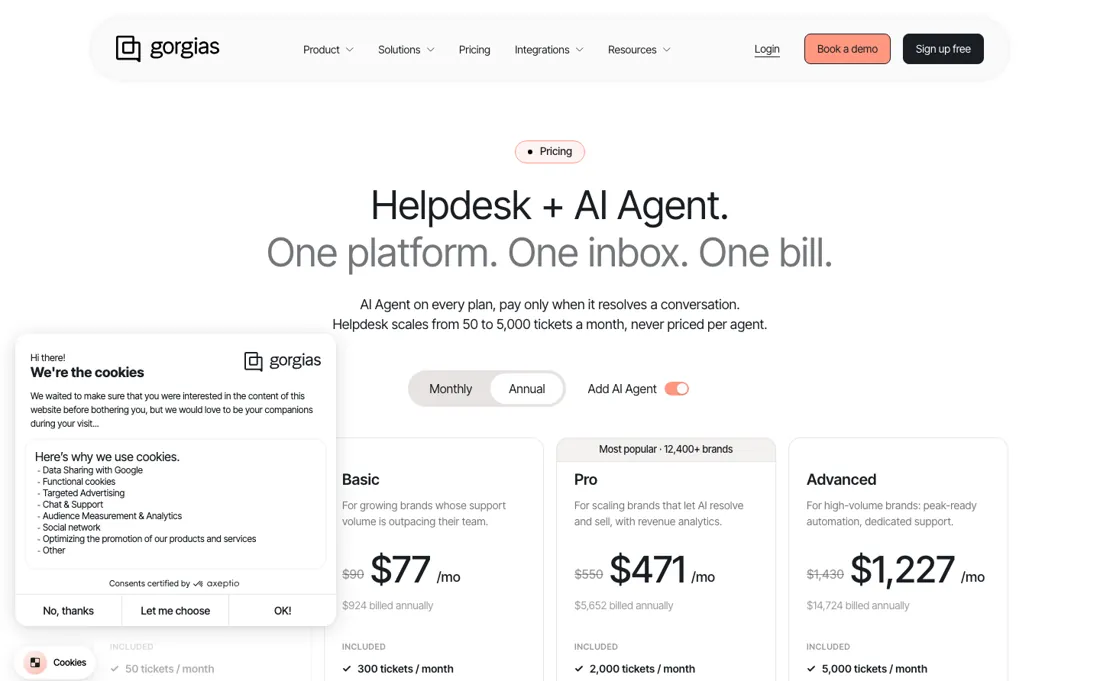
On Basic upwards your whole team can be in there without the bill moving, which is the main reason to choose this over a per-seat helpdesk. The cost sits on two meters instead, and both bite. Tickets beyond your allowance are $0.40 each on Starter and Basic, $0.36 on Pro and Advanced, so a bad week costs money rather than attention. And the AI agent -- the thing the homepage leads with -- is a separate $30 a month on the entry plan, which is three times the helpdesk it sits on.
So the honest entry price for the product as advertised is $40, not $10. Count a normal month's tickets and a busy month's, and price both. Then check the AI meter separately: past the included allowance the comparison table charges $1.00 per automated interaction on Starter, $0.90 on Basic and Pro and $0.85 on Advanced (read 7 October 2026). Price your expected volume at that rate before you switch the agent on.
Watch the video review
The video version of this review, from our YouTube channel.
What Gorgias does
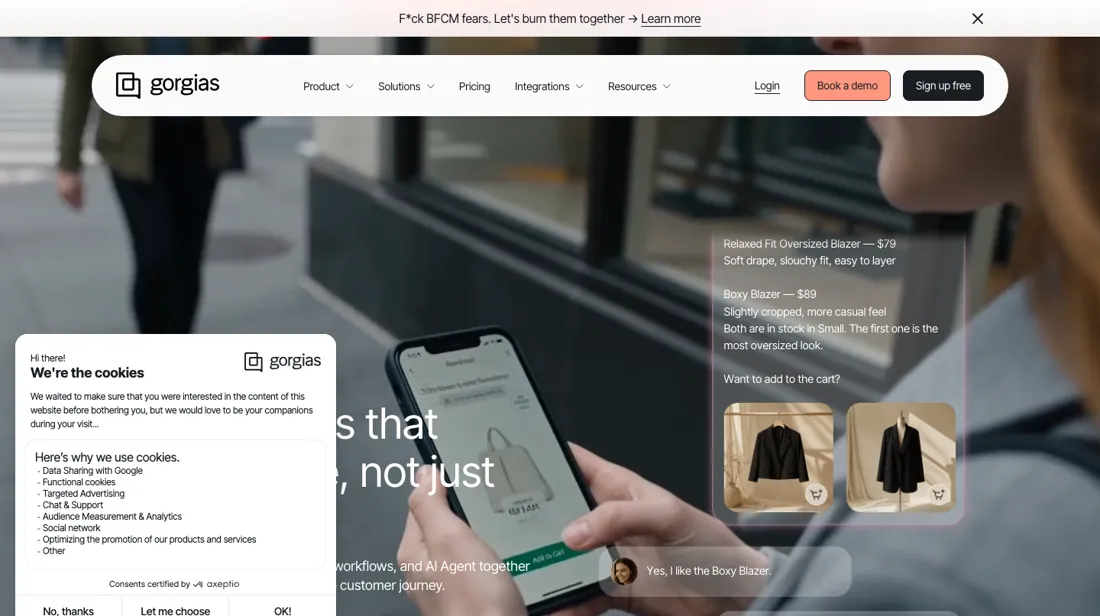
Helpdesk built for ecommerce: tickets, automations and an AI agent, priced by volume rather than by seat -- though the entry tier caps you at three users.
What buyers report about Gorgias
Hands-on: not tested by usDocumented by the vendor: 1 feature, read 2026-10-07Reported by buyers: G2, Capterra and practitioner reviews, Shopify App Store, read August 2026; Shopify App Store read 7 October 2026
Themes from the buyer-review sites listed at the foot of this page, read in August 2026; Shopify App Store read 7 October 2026. We have not run Gorgias ourselves, so this is other buyers' experience rather than ours. We summarise it here because the complaints are usually the part a vendor page leaves out.
- • It bills per ticket, not per seat, so your whole company can log in without buying licences. Reviewers name that as the reason it fits collaborative teams.
- • Fast to set up, and the partner ecosystem is the largest in ecommerce support.
- • On the Shopify App Store, recent merchant reviews (September 2026) credit the AI Agent with handling a real share of routine tickets, one brand putting it at over 50% of inquiries with CSAT holding, and several name their customer success manager as the reason the setup worked.
- • Per-ticket billing means your cost tracks volume, not headcount — and it is genuinely hard to forecast. Buyers in August 2026 described a cliff between Basic (300 tickets) and Pro (2,000 tickets) that left stores landing at 400-800 tickets paying the most per ticket of anyone; the plan prices they quoted then have since changed, so see the pricing section for the current figures.
- • The AI Agent costs about $1.00 per resolved conversation ($0.90 annual) on top of the ticket, and reviewers report it double-billing. It is Shopify-only.
- • Voice and SMS carry their own per-ticket charges, which buyers in August 2026 put at roughly $0.40 to $1.20; our pricing notes do not cover the voice and SMS rates, so check them on Gorgias's own page.
- • Reviewers report costs rising over time while support responsiveness fell. Reporting is shallow for data-heavy teams.
- • A five-year Shopify App Store reviewer (September 2026) says spam calls that leave a voicemail are still billed as Voice tickets, at $1 within their plan and $2.20 past it, even when Gorgias has flagged the call as spam; the mobile app cannot take Voice calls.
- • A July 2026 Shopify App Store reviewer switched for the live cart view in the ticket and found it gone; Gorgias confirmed in its reply that the live Shopify cart view was removed from the agent sidebar. The same reviewer would not switch the AI on at the $1.50 per conversation they were quoted.
- • Other low ratings there (June-August 2026) describe a UI redesign that dropped details teams relied on, a contact form without multilingual support, and email support with a stated 48-hour maximum response time.
Where the ratings disagree. The Shopify App Store is far more positive than Trustpilot's general profile: 579 of 705 ratings are five stars and 71 are one star (read 7 October 2026), and the five-star reviews often name a CSM, which suggests account-managed merchants write most of them.
When the paid plan is worth it
This is not priced per agent -- their own line -- and instead runs two meters that stack, so work out both before comparing anything. Starter is $40 a month all in: a $10 helpdesk with 50 tickets included and $0.40 per ticket beyond, plus the AI Agent at $30 with 30 automated interactions. Basic is $90 month-to-month or $77 billed annually ($924 a year), including 300 tickets and 30 interactions at the same overage rates.
The crossover is calculable and it comes sooner than you would guess. On Starter, tickets beyond the first 50 cost $0.40, so reaching Basic's $90 takes 125 extra tickets: at 175 tickets a month the two plans cost the same, and above that Starter is the more expensive option. If your desk handles more than about 175 tickets, move up. There is a second reason to leave Starter, and the pricing page prints it only in the comparison table: Starter allows 3 user seats, Basic and above allow 500.
The not-priced-per-agent advantage does not actually start until $77 a month, so a four-person team is on Basic whatever its ticket count says. The AI meter scales differently from the tickets: Starter and Basic both include exactly 30 automated interactions, Pro includes 190 and Advanced 530. Past the allowance the comparison table charges $1.00 per interaction on Starter, $0.90 on Basic and Pro and $0.85 on Advanced (read 7 October 2026).
An AI agent that works well is the line most likely to surprise you. What no tier fixes is the overage itself. The allowances rise; the per-ticket and per-interaction rates never reach zero, so a genuinely spiky month costs money on every plan.
How to actually use Gorgias
Count a normal month's tickets and a busy month's, separately, because the overage is where this bills. Tickets past your allowance are $0.40 each on Starter and Basic and $0.36 on Pro and Advanced, so a bad week costs you money rather than just attention -- and the allowances are small at the bottom: 50 tickets on Starter, 300 on Basic. Count your people too. Starter allows 3 user seats and Basic upwards allow 500, so if four people need the inbox, Starter is out whatever your volume says.
Do the crossover before you pick. Starter at $40 plus $0.40 a ticket reaches Basic's annual $77 at about 143 tickets a month -- so below that Starter is cheaper and above it Basic is, by a widening margin. At 300 tickets Starter would cost $140 against Basic's $77. Price the product as advertised: the AI agent is a separate $30 a month on the entry plan, three times the $10 helpdesk it sits on, so the honest entry price is $40, not $10.
Past the included 30 interactions the comparison table charges $1.00 each on Starter, $0.90 on Basic and Pro and $0.85 on Advanced. The $1.50 card rate we read in September was no longer on the page on 7 October 2026. Then take the advantage where it is real: from Basic up this is not priced per agent, which their own page says plainly. Put your whole team in the inbox, including the people who only answer occasionally -- it costs nothing there.
Where this section comes from: our research notes (141 words)
gorgias.com/pricing read on 8 September 2026 -- the four plan cards with the helpdesk and AI Agent components broken out, their included ticket and automated-interaction allowances, and the Compare plans table underneath, which is where the user-seat caps, the per-interaction rates and the API rate limits are published. gorgias.com/pricing.md returns 404, so there is no machine-readable version to check the rendered page against; the contradiction on the AI rate was found on 8 September by reading the cards and the table against each other, and was gone on 7 October.
Help-centre pages read on 7 October 2026 (docs.gorgias.com, Markdown versions): user-permissions-196938, export-tickets-from-gorgias-404844, connect-shopify-to-gorgias-81814, assign-tickets-manually-81834 and cancel-a-gorgias-subscription-289527. The pricing page was read again the same day: plan prices, allowances and ticket overage unchanged, and the comparison table's per-interaction rates ($1.00, $0.90, $0.90, $0.85) are now the only AI rates on the page.
Gorgias vs Zendesk, side by side
Where a vendor publishes a price, its column shows the entry price we read and when; where it does not, the column says so rather than filling in a figure from elsewhere. We do not average them into a score.
The natural comparison is Zendesk or Freshdesk — the standing comparison — Gorgias wins when your team is larger than your ticket volume suggests, and loses when your volume is high and steady.
Frequently asked questions
Can agents see the performance reports, or only admins?
Every role can see them. Gorgias's user-permissions table (read 7 October 2026) lets every role, down to Observer, view metrics, reports and custom dashboards and download that data to CSV. Only leads and admins can create dashboards or saved filters. The table does not say whether an agent can be limited to their own numbers.
Do agents see Shopify orders in the ticket, and who can refund?
Shopify connects on all Helpdesk plans, and only the account owner or an admin can connect it (help article 'Connect Shopify to Gorgias', read 7 October 2026). Once it is connected, every role sees the customer's order history. Refunds, cancellations and other Shopify actions from the ticket need the Basic role or higher, so Observer and Lite users cannot do them. Tickets can be assigned to agents or teams from the Lite role up. The same permissions table marks connecting a Gmail or Outlook account as 'Basic/Pro plans only'.
What can I export if I leave?
Ticket export to CSV is on all Helpdesk plans, for the account owner, admins and leads (help article 'Export tickets from Gorgias', read 7 October 2026). An export from a view holds ticket metadata but not the messages, up to 1 million tickets, and the link lasts 14 days. Message text only comes through an export from an analytics drill-down. That covers at most 30 days of data and 100,000 tickets, public messages only, without internal notes. Other data, such as macros or help-centre content, you request from Gorgias support as a custom export. Cancelling stops access at the end of the paid cycle, and Gorgias says it is not required to refund the rest.
Is this a hands-on review of Gorgias?
This is a researched assessment, not a hands-on test — where we've used a tool ourselves, we say so explicitly. We name what each tool is good and bad at, and we have no affiliate relationship with Gorgias — we earn nothing whether you sign up or not.
- Buyer reviews on G2, Capterra and practitioner reviews, Shopify App Store, read August 2026; Shopify App Store read 7 October 2026.
- Re-verified 7 October 2026 on their own pricing page; figures unchanged since 8 September.
- A dated screenshot of that pricing page, kept on this site as the receipt.
Others in this category
Reviewed customer support tools that share ground with Gorgias — comparable in what they do, not drop-in swaps:
New reviews, price changes we recorded, and the cost conditions we found. No sponsored placements. Unsubscribe anytime.
This is our researched assessment — not a paid placement. How we review →