Cloze Review (2026)25 Free Chats, Then $49/mo
 By Daan Haket · Researched and written with an AI assistant · who does what
On the same day, the App Store listing sold this at $49, $99 and $199 a month for 250, 750 and 2,000 conversations.
Shopify stores with a catalogue big enough that shoppers ask which item to buy, who want a chat assistant that reads live inventory and hands off to a person, and who will watch the transcripts.
your support volume is low, or you want proof from other merchants before you put an AI in front of customers — there are no reviews yet.
Transparency: the “Visit” links on this page are affiliate links — we may earn a commission if you sign up, at no extra cost to you. No vendor can pay for a better review or verdict. How we make money →
Pricing (2026)
✓ Pricing re-verified 11 Oct 2026
| Plan | Price | What you get |
|---|---|---|
| Free | no published price | 25 AI conversations a month, up to 100 synced products, 7 days history |
| Starter | $49 a month | 250 conversations a month, 1,000 synced products, full customisation, 30 days insights |
| Pro | $99 a month | 750 conversations, 10,000 products, advanced insights, 90 days history |
| Scale | $199 a month | 2,000 conversations, unlimited products, a year of history, priority support |
Summarised from the pricing notes below; the notes carry the conditions.
Free plan available: 25 AI conversations a month, up to 100 synced products, core assistant customisation and 7 days of conversation history. Paid tiers are Starter $49, Pro $99 and Scale $199 a month, each with $0.10 per additional AI conversation and a 3-day free trial. Starter covers 250 conversations a month and 1,000 synced products, with full customisation and 30 days of insights.
Pro covers 750 conversations and 10,000 products with advanced insights and 90 days of history, and Scale 2,000 conversations, unlimited products, a year of history and priority support. All charges are billed in USD and recur every 30 days. Worth knowing before you install. The vendor's own site, cloze.bot/pricing, advertised a different and cheaper ladder on the same day: Free forever with 50 conversations a month, Pro $29 a month and Business $79 a month.
Full pricing notes (2 more paragraphs)
On that page both paid tiers say unlimited conversations rather than a monthly allowance. Our link goes to the App Store listing, so the $49/$99/$199 ladder, with its caps of 250, 750 and 2,000 conversations, is what you pay when you install there. The screenshot further down is their own page exactly as we captured it. Developer Optify, Lyon, France; the app launched 24 April 2026, carries Shopify's “Built for Shopify” badge and had no reviews at all at the time of writing.
Re-read on 4 September 2026: both ladders still stood exactly as described above, and the listing had gained its first review — a single five-star note left on 14 August 2026 by a French store eight days in. Re-verified 11 October 2026: the App Store ladder (Free 25, Starter $49 for 250, Pro $99 for 750, Scale $199 for 2,000 conversations, $0.10 each beyond, 3-day trials) is unchanged, and so is the different ladder on cloze.bot/pricing (Free 50 conversations, Pro $29 and Business $79 with unlimited conversations). The listing still carries one review, dated 14 August 2026.
Plans change — always verify the live price on their site.
Category context: Customer Support. Across the 14 tools in this category that we researched with a public US-dollar price, the median entry price is about $20 a month (lowest paid plan as listed, per seat where the vendor prices per seat). Cloze’s entry price of $49 a month sits above that median. Compare pricing conditions in the Software Cost Atlas →
What the pricing page doesn’t say
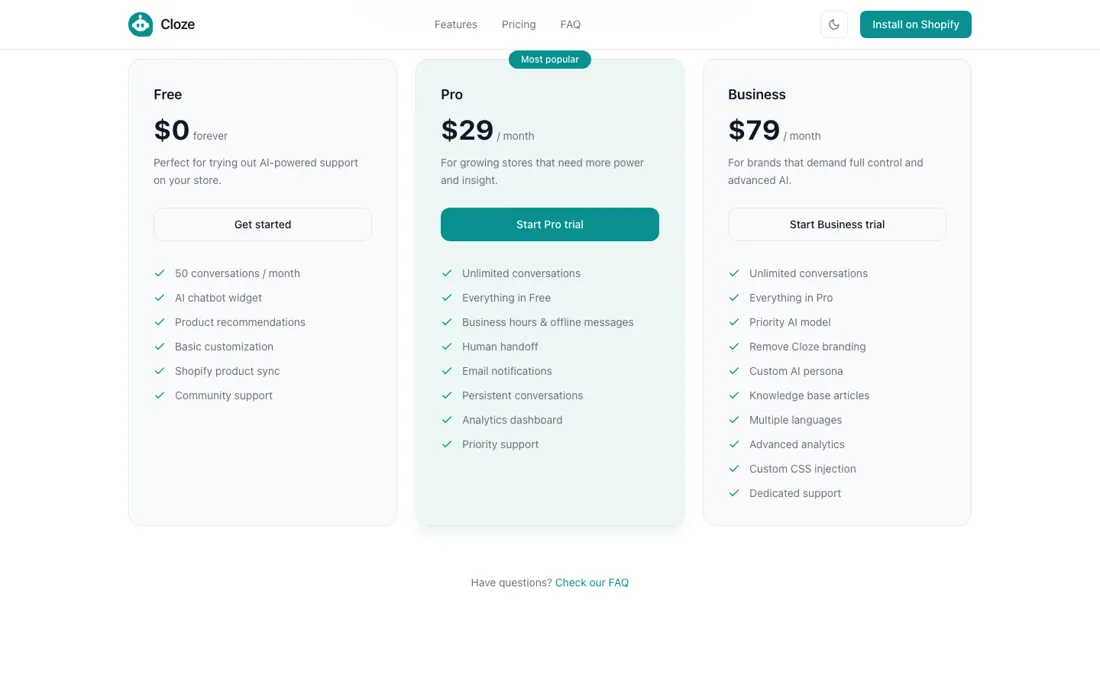
The vendor's own site sold it at $29 and $79, with unlimited conversations on both paid tiers. The screenshot below is that page. Two prices and two different meters for one product is not a discount you can claim, it is an inconsistency to ask about before you pay. The second is the track record, or the absence of one. The app launched 24 April 2026 and, as of 4 September 2026, carries exactly one review — five stars, left after eight days of use.
So there is next to no merchant experience to lean on, and the “Built for Shopify” badge is a technical bar, not a verdict on the answers. Also note what a conversation costs when it goes wrong. An assistant wired to live inventory and order tracking is answering with your data, and the free tier's 25 conversations a month is enough to test the tone but not enough to see it handle a bad day. The 3-day trial on paid plans is short for a support tool.
Watch the video review
The video version of this review, from our YouTube channel.
What Cloze does
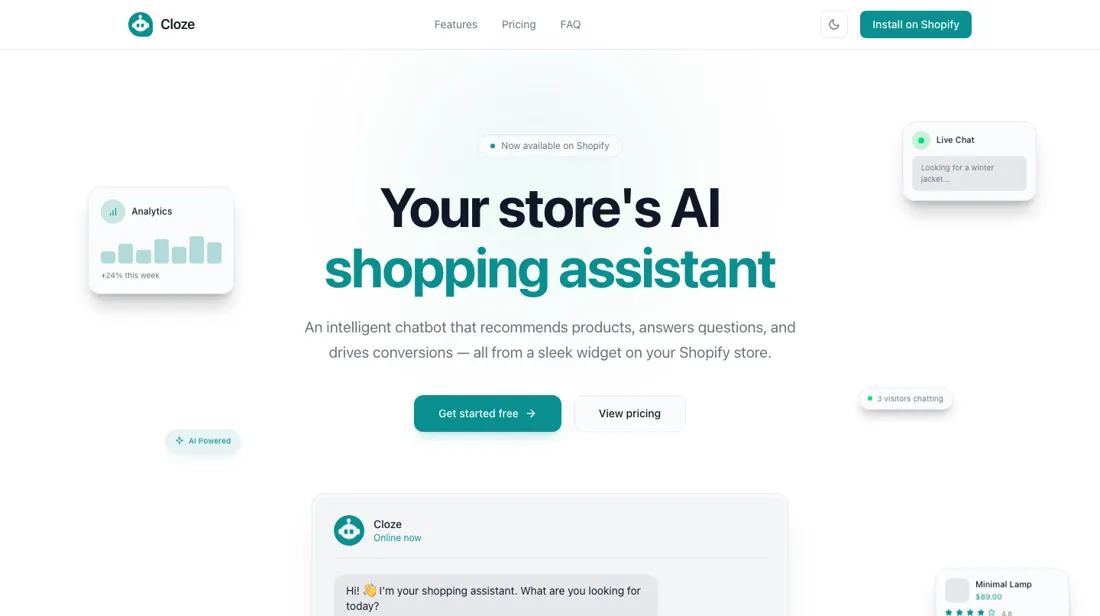
AI shopping assistant for Shopify: a chat widget wired to your live catalogue, inventory and knowledge base that answers product questions, compares items, tracks orders and hands off to a human. New listing: no reviews yet as of 19 Aug 2026.
When the paid plan is worth it
There is arithmetic in this pricing that is worth two minutes, because the overage rate is cheaper than the plans themselves. Every paid tier charges $0.10 for a conversation beyond the allowance. Inside the allowance you are paying $0.196 a conversation on Starter ($49 for 250), $0.132 on Pro ($99 for 750) and $0.0995 on Scale ($199 for 2,000). So the included conversations cost more than the extra ones on both of the lower tiers, and upgrading only starts to pay at a precise point.
Starter plus overage costs $49 plus ten cents a conversation; that equals Pro's $99 at exactly 750 conversations. Pro plus overage equals Scale's $199 at exactly 1,750. Below those two numbers, staying put and paying the overage is the cheaper choice, and the difference is real money at volume. What the tiers do buy outright is catalogue size and memory. Free syncs 100 products, Starter 1,000, Pro 10,000 and Scale unlimited — so a large catalogue can force a tier regardless of conversation volume.
History runs 7 days, 30, 90 and a year, which matters only if you plan to actually read the insights. Then there is the awkward part, and it is bigger than a discount. On 19 August 2026 the vendor's own site was selling this as Free with 50 conversations a month, Pro at $29 and Business at $79 — and on that page the paid tiers advertise unlimited conversations, not an allowance.
The App Store listing our link lands on rations the same product at 250, 750 and 2,000 conversations for $49, $99 and $199. So the two pages differ on the price and on the meter itself, which makes the arithmetic above worth doing only if you install through the App Store. We cannot tell you which page is current, and the vendor does not explain the gap anywhere we could find.
Read both, and ask them directly which applies to a Shopify install before you pay for a tier.
Our monthly capture read this vendor's pricing page every month from August 2026 to October 2026, and the amounts were the same all 3 times, including $29 and $79 from the pricing above. We keep watching — the registry records what moves.
Questions we checked
Facts about Cloze that would change a buying decision, and where we stand on each. An unanswered question does not mean the feature is missing; it means we have not confirmed it yet.
- Which price list bills a Shopify install, and which tier includes human handoff? Sources disagree
Applies to: App Store ladder Free/Starter/Pro/Scale versus cloze.bot ladder Free/Pro/Business.
Why it matters: the two ladders differ in price, meter and feature names, so the handoff and branding promises on cloze.bot cannot be mapped to the plan you are billed for.
Answer: apps.shopify.com/cloze (read 11 October 2026) sells Starter $49, Pro $99 and Scale $199 with a conversation meter; cloze.bot/pricing and cloze.bot/faq (read the same day) sell Pro $29 and Business $79 with unlimited conversations and put human handoff on Pro and Business. Shopify bills app charges through the App Store listing, but neither source says which ladder applies.
Checked: Shopify App Store listing (2026-10-11); Cloze pricing (2026-10-11); Cloze FAQ (2026-10-11)
Have a public source that answers one of these? How we review explains how we check and correct.
How to actually use Cloze
Start on the free tier and read every one of the 25 conversations rather than counting them: what you are testing is whether the answers are right about your products, not whether the widget looks good. Feed it your worst cases first — the item with three near-identical variants, the policy question you get every week, the order that shipped late — because those are the conversations that cost you a customer when they go wrong.
Set the human handoff up before you go live, not after. When you do move to a paid plan, count your likely monthly conversations first and compare staying on the lower tier with overage: Starter plus $0.10 a conversation only becomes more expensive than Pro past 750 conversations, and Pro only loses to Scale past 1,750. And before you pay anything, ask the vendor which page applies to a Shopify install — their own site quotes lower prices and unlimited conversations, the listing quotes higher prices and a monthly cap, and that answer changes the whole calculation.
Distilled from apps.shopify.com/cloze and cloze.bot/pricing, both read 19 August 2026. Re-verified 11 October 2026 on apps.shopify.com/cloze (plan block and reviews), cloze.bot/pricing and cloze.bot/faq, all read 11 October 2026.
Frequently asked questions
What counts as a conversation, and do unused ones carry over?
The FAQ on cloze.bot/faq (read 11 October 2026) defines a conversation as a unique chat session between the AI and a visitor, however many messages the visitor sends inside it, and says conversations reset monthly, so unused ones do not carry over. When a session ends and a new one starts is not stated: not confirmed. On the App Store plans each conversation beyond the allowance costs $0.10.
Can a person take over a chat the AI cannot answer?
Yes, on paid plans per the vendor. The cloze.bot FAQ (read 11 October 2026) says that on its Pro and Business plans you can enable human handoff, take over the conversation, reply and release it back to the AI. Those are the plan names on cloze.bot; the App Store listing you install from sells Starter, Pro and Scale and does not list handoff per tier, so which listing tier includes it is not confirmed.
How do I cancel?
From your Shopify admin under Apps, Cloze, Billing; the cloze.bot FAQ (read 11 October 2026) says there are no cancellation fees or long-term contracts. Charges on the App Store listing recur every 30 days.
Is this a hands-on review of Cloze?
This is a researched assessment, not a hands-on test — where we've used a tool ourselves, we say so explicitly. We name what each tool is good and bad at, and we earn a commission only if you sign up, at no cost to you.
- Read 2026-08-19, re-verified unchanged 2026-09-04 on apps.shopify.com/cloze, listed as “Cloze: AI Shopping Assistant”.
- A dated screenshot of that pricing page, kept on this site as the receipt.
Others in this category
Reviewed customer support tools that share ground with Cloze — comparable in what they do, not drop-in swaps:
New reviews, price changes we recorded, and the cost conditions we found. No sponsored placements. Unsubscribe anytime.
This is our researched assessment — not a paid placement. The “Visit” links on this page are affiliate links: we may earn a commission if you sign up, at no extra cost to you, and it never changes our take. How we review →