Tidio Review (2026)
 By Daan Haket · Tested hands-on · written with an AI assistant · who does what
The AI number on the homepage and the AI number on the pricing page do not agree, and the pricing page is the lower of the two.
support teams that want an AI agent and a help desk from the same vendor and can size all three meters — billable conversations, Lyro AI conversations and Flows visitors — against their own volume before they commit, and Shopify, WordPress or Wix stores that want to run live chat at zero and treat the 50 free Lyro conversations as a measurement of whether the AI answers their questions at all.
you need the AI agent to keep answering past the first 50 conversations without paying, you cannot get the over-cap rate and the Plus usage rate quoted before signing, you want one per-seat price rather than three independent meters, or you are buying on the strength of the 67 percent resolution figure and need it as a commitment rather than an average.
Transparency: the “Visit” links on this page are affiliate links — we may earn a commission if you sign up, at no extra cost to you. No vendor can pay for a better review or verdict. How we make money →
Tested by our team on 21 October 2026 on the 7-day trial that starts with a new account, without a card: Daan created the account and our AI assistant ran the test in Daan's browser. We gave the Lyro AI agent five questions and answers about a made-up shop, asked it ten questions in the Playground, two it could not know, and changed one answer to see how fast it followed. The chat widget was not installed.
- Sign-up requires a website URL ('Can't be empty!'). Within minutes Tidio read 71 pages of the site we entered into Lyro's knowledge on its own. The source list can delete or set an audience in bulk, but excluding a source without deleting it is one source at a time. Before testing our five Q&As we deleted all 71 website sources Tidio had imported automatically, so the answers were checked against our test knowledge alone.
- Usage and plan showed 'AI conversations 0/50' marked 'Lifetime quota' for Lyro. After 13 Playground questions it still read 0 / 50: Playground questions do not count.
- A CSV with the columns Question and Answer was accepted as it was (5 Q&As).
Pricing (2026)
✓ Pricing re-verified 10 Oct 2026
| Plan | Price | What you get |
|---|---|---|
| Free | Free | 50 billable conversations, 100 Flows visitors reached, 50 Lyro AI conversations (lifetime) |
| Starter | 24.17 a month billed annually / 29 monthly | 100 billable conversations, 10 seats, 7-day free trial |
| Growth | 49.17 a month billed annually / 59 monthly | 250 billable conversations, cap 2,000, 10 seats, 7-day free trial |
| Plus | 300 a month (both columns) + monthly usage | Adds usage on top; discounted usage rates unspecified |
| Premium | contact-for-pricing | — |
Summarised from the pricing notes below; the notes carry the conditions.
The plan table opens on the annual column, so the first figures on the page are not what month-to-month costs. Starter is 24.17 a month billed annually against 29 paid monthly, Growth starts at 49.17 annually against 59 monthly, and the two stand-alone add-ons follow the same 20 percent step: the Lyro AI Agent from 32.50 annually against 39 monthly, Flows from 24.17 against 29.
Plus is 300 a month in both columns and adds usage on top; Premium is contact-for-pricing. Tidio's own homepage quotes the higher, monthly number (“Paid plans from $29/mo, no surprise upgrades”), which makes the marketing page the more conservative of the two places you can read a price. The table rendered in euros on our reading while the same numerals appear with dollar signs on other retrievals of the same URL, so treat the figure rather than the symbol as the fact and confirm the currency at checkout.
Full pricing notes (2 more paragraphs)
What you pay is decided by three separate meters, not by the plan name. The free plan carries 50 billable conversations, 100 Flows visitors reached and 50 Lyro AI conversations, and the comparison table's own footnote makes that last allowance a lifetime one rather than a monthly one. Starter covers 100 billable conversations, Growth starts at 250 and the table caps it at 2,000, both with 10 seats and a 7-day free trial.
Lyro conversations are upgradable from 50 to 1,000 and Flows visitors from 2,000 to 100,000. Two things the page does not say: what a conversation over the cap costs, and what the “discounted usage rates” next to Plus's “+ monthly usage” actually are. On Plus that unquoted rate is the whole variable, because the 300 is only the entry fee.
Plans change — always verify the live price on their site.
Category context: Customer Support. Across the 14 tools in this category that we researched with a public US-dollar price, the median entry price is about $20 a month (lowest paid plan as listed, per seat where the vendor prices per seat). Tidio’s entry price of $29 a month sits above that median. Compare pricing conditions in the Software Cost Atlas →
What the pricing page doesn’t say
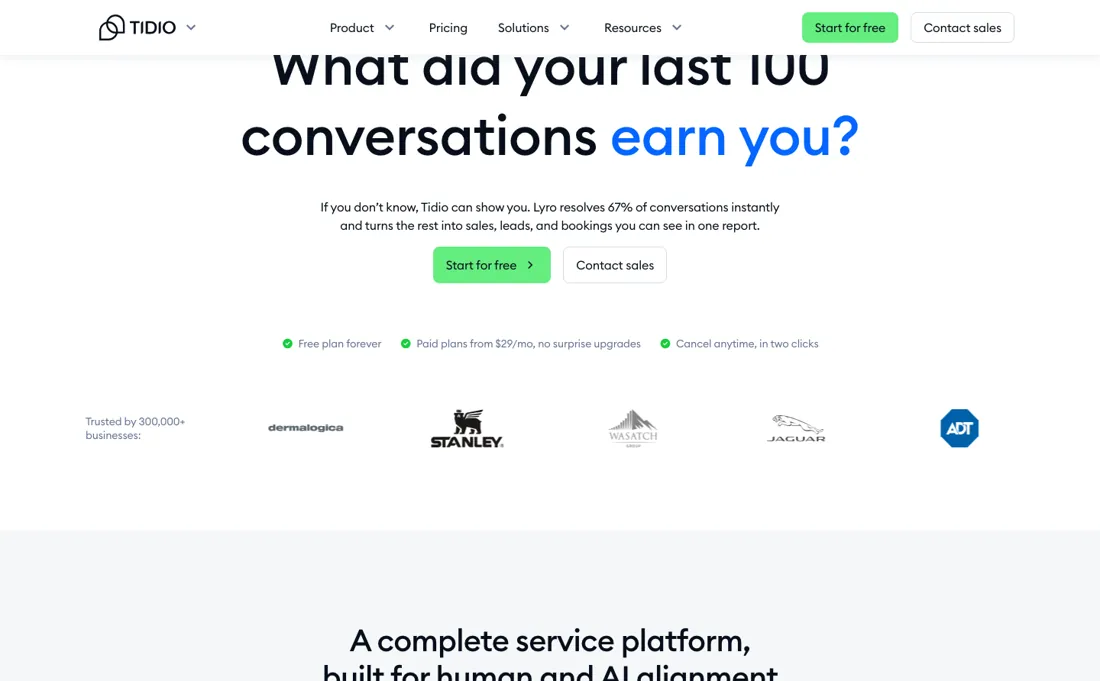
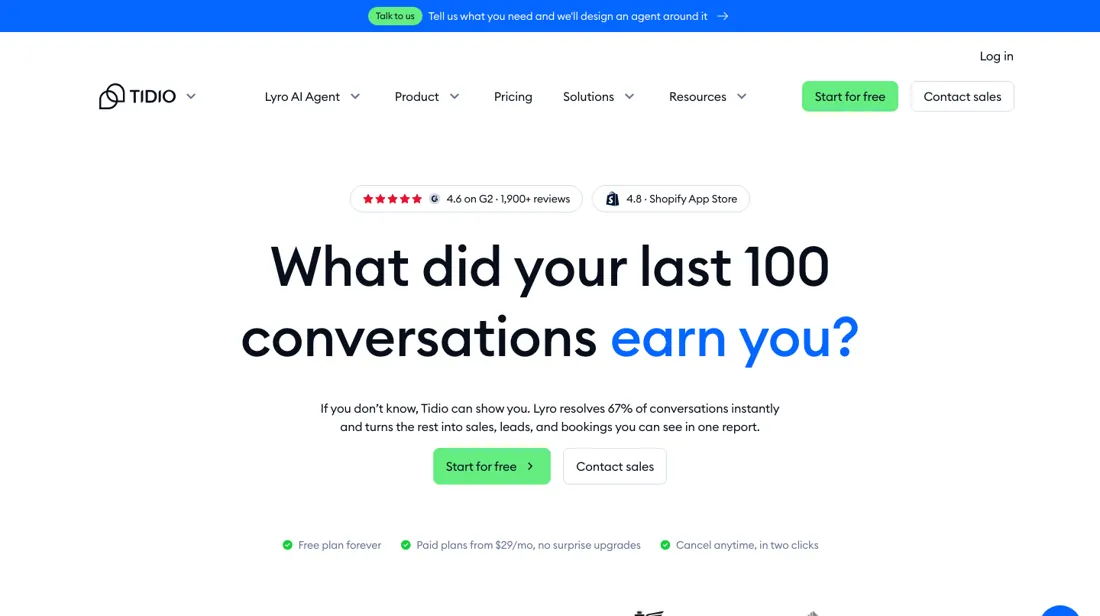
The homepage, read 24 August 2026, says Lyro “resolves 67% of conversations instantly” and repeats it as a statistic: 67% of conversations resolved instantly. The pricing table, read the same day, lists “Guaranteed 50% Lyro AI resolution rate” as a Premium feature — the most expensive tier on the page. So the figure the marketing quotes is 17 points above the figure the company is willing to guarantee, and the guarantee is only available if you talk to sales about the top plan.
Both numbers can be true at once; a typical result and a contractual floor are different things. But it does mean that if you are buying on the strength of 67 percent, you are buying an average someone else achieved, not a commitment to you. Second, the plan table opens on annual billing. The headline 24.17 and 49.17 become 29 and 59 the moment you click Monthly, and the two add-ons move 32.50 to 39 and 24.17 to 29.
Nothing is hidden — the toggle is right there and the annual column is honestly labelled “2 months free” — but the number you remember from the pricing page is about 20 percent below the number you pay unless you commit for a year. Tidio's own homepage quotes the monthly figure, so the two pages leave a buyer with two different first impressions of the same plan. Third, “Free plan forever” is true for the help desk and not for the AI.
The free tier's 50 Lyro AI conversations are one-off: the comparison table footnote reads that your first 50 conversations are free (lifetime), and the same applies to the 100 Flows visitors. The live chat and ticketing side really does keep working at zero, but the AI agent that the whole homepage is built around stops after 50 conversations ever, which for a shop with any traffic is a matter of days.
Read the free plan as a trial of Lyro inside a permanently free help desk, not as a free AI agent. In our own test on 21 October 2026 Lyro answered ten of ten questions correctly from five answers we gave it, said it had no information on the two it could not know and offered 'Talk to a person', but it would not work out whether one month fell inside a 37-day warranty.
Watch the video review
The video version of this review, from our YouTube channel.
What Tidio does
Live chat, ticketing and the Lyro AI agent in one platform: AI answers routine questions from your own data, hands the rest to the team with context, and Flows chase leads proactively. Lyro also plugs into Zendesk, Intercom, Salesforce and 20+ platforms without migration, but only on Premium.
What buyers report about Tidio
Hands-on: tested 2026-10-21Reported by buyers: Shopify App Store, read August 2026
Themes from the buyer-review sites listed at the foot of this page, read in August 2026. We tested Tidio ourselves on 2026-10-21, but one test is a narrow sample, so here is what other buyers report. We summarise it here because the complaints are usually the part a vendor page leaves out.
- • The Shopify listing sits at 4.8 across 1,254 reviews with 86% at five stars, and the reviews with real tenure behind them are about the AI agent doing shift work. Moonchild Skunkworx (Slovenia, six months, 24 August 2026) credits it with handling support without much time spent and notes it learns from the site's own content; The Fire Alarm Supplier (United States, over three years, 18 July 2026) values it for answering common questions outside business hours.
- • Capterra is 4.7 across 590 reviews, and 93% of the reviewers there are small businesses. The praise clusters on setup speed and on Lyro cutting repetitive tickets — a government administration director reports an immediate drop in repeat tickets; several reviewers name having email, WhatsApp, Instagram and Facebook in one inbox as the reason they stayed.
- • Billing is the recurring complaint on Trustpilot and it is specific rather than vague. One reviewer (31 October 2025) says the rate was doubled without notification and a full year charged, then cancellation and refund refused; another (8 September 2025) reports a price rise with no notice, a move to a higher plan, and no way to stop the recurring charge. The same theme appears on the Shopify listing: Pom D'Azur (France, 25 days, 26 May 2026) reports being charged twice and refused a refund despite documentation.
- • The costliest failure a reviewer describes is the bot being confidently wrong. Piel Eterna (Spain, about a month, 15 March 2026) writes that the bot gave incorrect stock availability and puts the damage at 40 chats' worth of potential sales, on answers that did not match what it had been trained on.
- • Two limits show up that the marketing does not. TopJob (United States, over a year, 13 July 2026) says the conversations and answers cannot be exported — and the vendor's public reply acknowledges the limitation rather than disputing it. Direct Discount Furniture & Mattress (United States, one day, 21 May 2026) reports that the Shopify App Store listing and Tidio's own site do not agree on pricing and features. On Capterra a digital marketing manager reports that the conversation limit counts greetings sent to visitors, and several marketers note Lyro does not fully cover WhatsApp.
Where the ratings disagree. Three platforms, three different scores, and the difference tracks who bothers to write. Shopify App Store is 4.8 over 1,254 and Capterra 4.7 over 590; Trustpilot is 3.8 over 224 with 24% at one star — close to a quarter. The Shopify and Capterra records are largely people describing installation and the chatbot working; the Trustpilot record is largely people describing what happened at renewal. Neither is fake, and they are not answering the same question. One thing no platform supplies: not a single reviewer read here reports measuring their own Lyro resolution rate, so the 67% on the homepage and the guaranteed 50% in the pricing table remain vendor figures that the buyer record neither confirms nor contradicts.
Pages read (August 2026): Trustpilot
When the paid plan is worth it
The step that needs thinking about is not Starter to Growth, it is Growth to Plus. Growth at 59 a month month-to-month buys advanced analytics, user permissions, automatic assignment and macros against Starter's basic set, and it lifts the conversation cap from 100 to a ceiling the comparison table puts at 2,000. That is a legible trade: you can count your conversations and decide. Plus is a different kind of purchase.
It is 300 a month plus usage, and the usage rate is described as discounted but never printed. The features you are buying are organisational rather than functional: departments, multiproject, custom branding, a dedicated success manager, wire transfer, custom seat counts. If you need departments and SSO you already know it. If you are looking at Plus to escape a conversation cap, get the per-conversation rate in writing first, because on this plan that number decides the bill and it is the one figure the pricing page withholds.
Premium is worth one sentence: it is where the 50 percent Lyro resolution guarantee and pay-per-resolution billing live. That is the only place on the page where Tidio takes on any of the risk of the AI not working, and it is quoted by conversation with sales rather than by price.
Our monthly capture read this vendor's pricing page every month from August 2026 to October 2026, and the amounts were the same all 3 times. We keep watching — the registry records what moves.
What we found running Tidio ourselves
The first findings are at the top of this page. The rest:
- Lyro answered nine of the ten fact and paraphrase questions fully. For the warranty question it repeated the correct 37-day term but did not determine whether one month fell within it. Each answer was marked 'AI response based on your data sources'.
- Asked whether a fault after one month was covered by a 37-day warranty, Lyro gave the 37 days but said 'I'm not able to determine whether one month falls within that period'.
- For the two questions our data did not answer (Sunday opening, return costs) it said it had no information and offered 'Talk to a person'; it made nothing up.
- After we changed the warranty from 37 to 41 days, the next question was answered with 41 days.
What this test does not show:
- Real visitor conversations through an installed chat widget, and so the use of the 50 Lyro conversations
- Handing over to a person, Flows, and the email and social channels
- Lyro Actions, Procedures and Guidance
- What happens when the 7-day trial ends and the account moves to the free plan
- Languages other than English
Most of our reviews are researched rather than run — how we review explains which is which, and why we do not pretend otherwise.
Questions we are still checking
Facts about Tidio that would change a buying decision, and where we stand on each. An unanswered question does not mean the feature is missing; it means we have not confirmed it yet.
- What does a conversation over the included quota cost on Plus? Still checking
Applies to: Plus.
Why it matters: Plus is priced from 300 a month plus monthly usage at 'discounted usage rates' that the pricing page does not print.
Checked: Tidio pricing (2026-10-10)
Have a public source that answers one of these? How we review explains how we check and correct.
How to actually use Tidio
Install on the free plan and spend the first 50 Lyro conversations deliberately, because they are all you get. Test Lyro in its Playground first: in our test on 21 October 2026, 13 Playground questions left the counter at 0 of the 50 lifetime conversations, so you can check its answers against your own FAQ before a single real conversation is spent. Know too that sign-up asks for your website URL and Tidio then reads that site into Lyro's knowledge on its own (71 pages of ours within minutes); sources can be deleted in bulk but excluded only one at a time.
Then let it answer live traffic and read the transcripts: what you are measuring is how often it answers from your own data without guessing and how often it hands over. That number, not the published 67 percent, is what a paid Lyro quota is worth to you. Size the meters before you pick a plan. Count the conversations your team actually handles in a month against Starter's 100 and Growth's 250-to-2,000 band, and count them separately from the Lyro quota, because the two are billed apart and a busy chat widget can exhaust the AI allowance while the help desk plan still has room.
If Flows matters to you, the third meter is visitors reached, not conversations. Then ask two questions in writing before you upgrade: what a billable conversation over the cap costs, and — if Plus is on the table — what the discounted usage rate per conversation is. Neither is on the pricing page, and on the plans where they apply they decide the bill. Pay monthly for the first month or two even though it costs 20 percent more; the annual column is the cheaper one only if the tool survives its trial.
Distilled from www.tidio.com/pricing/, read with both the Monthly and the Annually column selected, and www.tidio.com — both read 24 August 2026. Re-verified 10 October 2026 on www.tidio.com/pricing/ and the help article "The monthly conversations limit" (help.tidio.com/hc/en-us/articles/11874534946460).
Frequently asked questions
What counts as a billable conversation, and what happens when I hit the limit?
Per Tidio's help article "The monthly conversations limit" (updated 19 May 2025, read 10 October 2026): a conversation counts once an agent closes it with Solve, however many messages it holds, and the quota covers website live chat, email tickets and the Messenger, Instagram and WhatsApp integrations. Lyro AI, Flows and email campaigns are metered separately. At 80% a banner appears; at the limit you can no longer reply to incoming messages or see their details until you upgrade or the quota resets, normally on the first day of the month.
How many agents can I add, and when do plan changes take effect?
Per tidio.com/pricing, read 10 October 2026: up to 10 agents on the self-serve plans and a custom number on Plus. Upgrades and downgrades take effect at the start of your next billing cycle, and when the 7-day trial ends the account drops back to the Free plan unless you upgrade.
Is this a hands-on review of Tidio?
Yes. We tested Tidio ourselves on 2026-10-21; the section above says what we tested, what we found and what we did not test, and where a figure comes from the vendor's own documentation instead. Most of our reviews are researched rather than run; we say which is which. We name what each tool is good and bad at, and we earn a commission only if you sign up, at no cost to you.
- Buyer reviews on Shopify App Store (listed as “Tidio: AI Chatbot & Live Chat”), Capterra, Trustpilot, read August 2026.
- Read 2026-08-24 on www.tidio.com/pricing/ with both billing columns clicked, and on www.tidio.com.
- A dated screenshot of that pricing page, kept on this site as the receipt.
- Our own hands-on session with Tidio (2026-10-21), written up in full further down this page.
Others in this category
Reviewed customer support tools that share ground with Tidio — comparable in what they do, not drop-in swaps:
New reviews, price changes we recorded, and the cost conditions we found. No sponsored placements. Unsubscribe anytime.
This is our researched assessment — not a paid placement. The “Visit” links on this page are affiliate links: we may earn a commission if you sign up, at no extra cost to you, and it never changes our take. How we review →