 Voye Review (2026)The Yearly Plans Cost More Per GB
eSIM data pooling genuinely beats classic roaming for traveling teams, but the honest homework is coverage-and-speed on YOUR corridors: quality varies by country and local carrier partner, so pilot with two or three of your heaviest travelers before migrating everyone. And note the vendor-cited savings numbers are marketing math until your own invoice confirms them.
Visit Voye → Affiliate link — the rest of this page is the honest version, including who should skip it.
Watch the 2-minute review
Same honest take, in video form — from our YouTube channel.
⚡ Short on time? Watch the 30-second verdict Short.
Pricing (2026)
✓ Pricing re-verified 6 Sep 2026
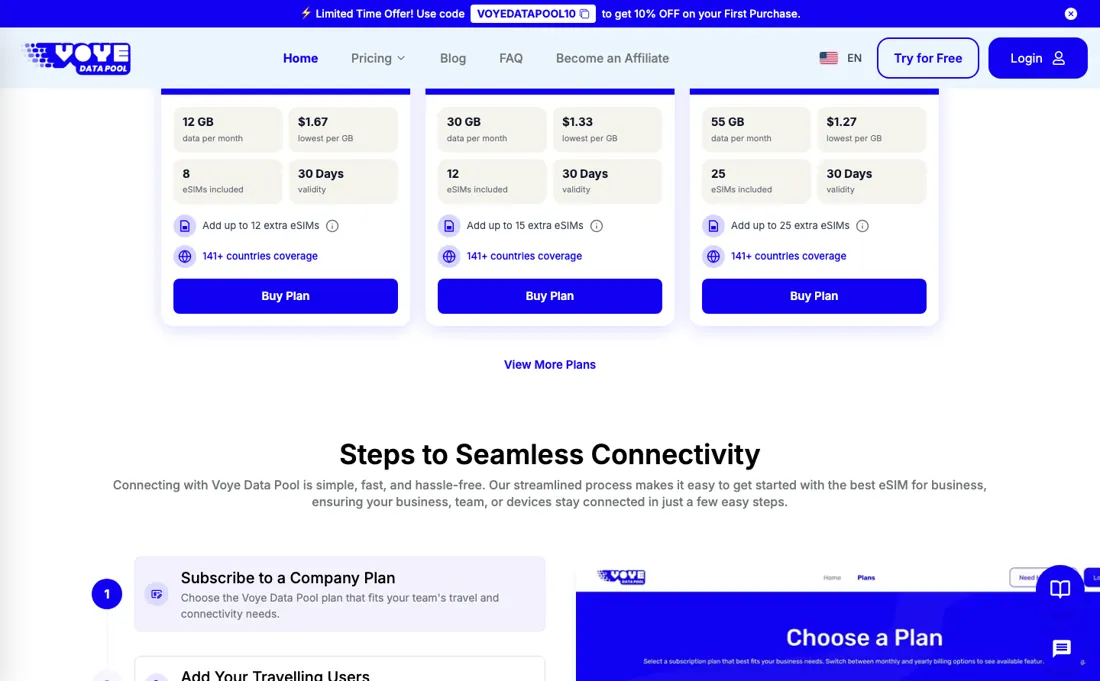
Published plans (read 6 September 2026 on their plans page). Monthly, 30-day validity: $9.99 for 5 GB, $19.99 for 12 GB, $39.99 for 30 GB, $69.99 for 55 GB, $119.99 for 100 GB — $2.00 down to $1.20 per gigabyte. Yearly, a single payment, 365-day validity: $500 for 200 GB, $1,000 for 450 GB, $2,000 for 950 GB, $3,500 for 1,800 GB — $2.50 down to $1.94 per gigabyte.
Three-month billing is exactly three times the monthly price, with no discount. Enterprise — unlimited eSIMs, priority support and onboarding — is quoted by their sales team. Plans change — always verify the live price on their site.
Voye’s pricing page, as we read it
What Voye does
Pooled eSIM data for travelling teams, billed on actual usage rather than prepaid bundles, with per-user spend controls. Coverage and speed vary by country and carrier partner, so pilot your heaviest routes first — the vendor's roaming-savings figures stay claims until your invoice confirms them.

What buyers report about Voye
Recurring themes from the buyer-review sites listed at the foot of this page, read in August 2026. We have not run Voye ourselves, so this is other buyers' experience rather than ours. We summarise it here because the complaints are usually the part a vendor page leaves out.
- • Covers 130+ countries with plans from 0.5GB to unlimited and validity up to 365 days.
- • A free 100MB test at home before you travel, full hotspot sharing, and 24/7 multilingual support — the free test in particular removes the main risk.
- • App Store ratings are low, driven by bugs — the app is the weak part rather than the connectivity.
- • Speed and activation complaints come up, and coverage varies in remote areas. Check your specific destination rather than the country count.
- • It ranks 28th of 50 providers on average plan price — mid-range rather than cheap.
Why a year up front costs more per gigabyte
Voye publishes its rates, and the page rewards a calculator (read 6 September 2026). Monthly plans run $9.99 for 5 GB, $19.99 for 12 GB, $39.99 for 30 GB, $69.99 for 55 GB and $119.99 for 100 GB, each valid 30 days. The yearly plans are a single payment valid 365 days: $500 for 200 GB, $1,000 for 450 GB, $2,000 for 950 GB and $3,500 for 1,800 GB. Divide, and the ladder inverts.
The monthly plans fall from $2.00 a gigabyte to $1.20 as they grow. The yearly plans run $2.50, $2.22, $2.11 and $1.94. Buying a year up front costs more per gigabyte, not less — and the two plans that share the name Small Businesses make the point sharply: twelve months of the $39.99 monthly plan is $479.88 for 360 GB, against $500 for 200 GB on the yearly one, which also includes ten eSIM seats where the monthly includes twelve.
What the yearly plans actually buy is expiry. A monthly allowance resets every 30 days and unused data goes with it; the yearly pool sits there for a year. If your travel is seasonal — three heavy months and nine quiet ones — that is the whole argument, and it is a real one. If it is steady, the monthly ladder is cheaper on every measure. What upgrading does not fix is coverage.
Every tier rides the same carrier partners, so a country where the network is mediocre stays mediocre on the $3,500 plan. Paying more buys gigabytes and eSIM seats, never a better signal. Pilot your own corridors before you migrate anyone.
How to actually use Voye
Work out your gigabytes before you look at the plans, because gigabytes are the only thing being priced. Pull your last three months of roaming charges, list the trips and the data actually used, and you will know which of the five monthly tiers you belong in. Then decide expiry before you decide size. Monthly allowances die after 30 days; the yearly plans hold their data for 365. Steady travel is cheaper on the monthly ladder — twelve months of the $39.99 plan gives you 360 GB for less money than the $500 yearly plan's 200 GB.
Seasonal travel is the case where paying more per gigabyte to stop the clock is worth it. Then pilot on your real corridors with two or three of your heaviest travellers before migrating the team. eSIM quality varies by country and by local carrier partner, and no tier changes that. And settle one thing in writing: whether the spend controls are hard caps or alerts. A cap that cuts someone's data off in a foreign city is worse than an overage charge.
Distilled from Plans, per-gigabyte arithmetic and eSIM seat counts read on voyedatapool.com/plans on 6 September 2026. The plan table is rendered client-side, so the figures were taken from the plan objects embedded in that page's own payload rather than from the rendered text; the FAQ on the same page is the source for the Enterprise tier and the sales contact.
The natural comparison is Airalo for Business or Truphone — the business-eSIM field — compare per-GB rates on your actual destination list, not the global average.
More on Voye
Everything we publish about Voye links back here — the review stays the honest hub:
The ex-banker filter — the same yardstick on every review (how we review): My ex-banker filter is simple: does Voye remove a real cost — time, errors, missed revenue — bigger than what it charges?
Frequently asked questions
What should I weigh before buying Communication & Voice software?
Generally yes, since this category is built for it, but the details that bite are timezone handling, how per-seat cost scales as the team spreads, and whether numbers, routing or coverage exist in the countries your people actually sit in. Availability varies far more by country than the marketing pages suggest, so check your specific regions before committing.
Is this a hands-on review of Voye?
This is a researched assessment, not a hands-on test — where we've used a tool ourselves, we say so explicitly. We name what each tool is genuinely good and bad at, and we earn a commission only if you sign up, at no cost to you.
- Buyer reviews on Trustpilot, eSIM comparison sites and app-store reviews, read August 2026.
- Voye’s own published pricing page.
- A dated screenshot of that pricing page, kept on this site as the receipt.
Others in this category
Reviewed communication & voice tools that share ground with Voye — comparable in what they do, not drop-in swaps:
New dossiers, cost-traps we found, and tools that earned a keep — no hype, no sponsored-disguised-as-advice. Unsubscribe anytime.
This is our researched assessment — not a paid placement. The “Visit” links on this page are affiliate links: we may earn a commission if you sign up, at no extra cost to you, and it never changes our take. How we review →