 UniTel Voice Review (2026)Extra Users Cost $9.99
UniTel Voice is a virtual phone layer, not a full unified-comms suite — you won't find the deep team messaging, video meetings and contact-center features pricier platforms bundle.
Visit UniTel Voice → Affiliate link — the rest of this page is the honest version, including who should skip it.
Watch the 2-minute review
Same honest take, in video form — from our YouTube channel.
⚡ Short on time? Watch the 30-second verdict Short.
Pricing (2026)
✓ Pricing re-verified 9 Sep 2026
Three plans, no contracts: Solo $9.99/mo, Team $19.99/mo and Office $29.99/mo, each with one phone number and unlimited minutes. Annual billing takes 30% off, making them $6.99, $13.99 and $20.99 a month. Solo is one user, Team carries unlimited users, and Office includes three with additional users at $9.99 each a month. The plan set we recorded in August — Start-Up, Unlimited at $24.99 and Office-Max at $69.99 — is no longer offered on the page.
Support is US-based, there is a 30-day money-back guarantee, and every plan includes a professionally recorded greeting. One caveat on those unlimited minutes: the pricing FAQ offers 3.9¢ per minute above "the minutes on your plan" and still names an Office-Max plan the page no longer sells, so the page contradicts its own cards — probably stale text, but unconfirmed. Plans change — always verify the live price on their site.
What the price did
We capture UniTel Voice’s own pricing page every month and keep the figures, so this is our record of the page — not a forecast, and not someone else’s summary.
One of the steadiest pages we track: our July and August 2026 captures of UniTel Voice's pricing page are byte-for-byte identical. Both lead with $9.99 a month and carry the same $9.99 per additional user, and re-reading it on 17 August 2026 returned the same four plans. Three readings, no movement.
What the pricing page doesn’t say
For a solo founder or small team that just needs a professional number, auto-attendant and call routing, that focus is exactly the point; for a larger org wanting one platform for everything, it will feel thin.
What UniTel Voice does
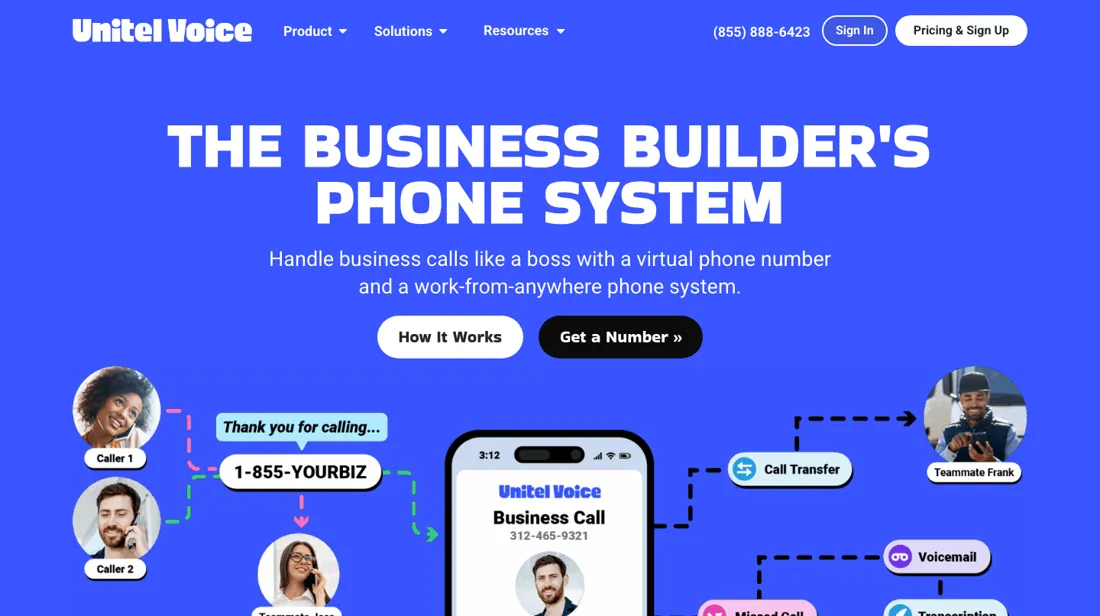
Virtual business phone system for small teams. Get a toll-free or local number with auto-attendant, call routing and a mobile app — no hardware.
What buyers report about UniTel Voice
Recurring themes from the buyer-review sites listed at the foot of this page, read in August 2026. We have not run UniTel Voice ourselves, so this is other buyers' experience rather than ours. We summarise it here because the complaints are usually the part a vendor page leaves out.
- • One of the cheapest virtual phone systems going, with no contract and a 30-day trial. Reviewers writing in August 2026 praised an unlimited-user tier at $24.99; that plan has since been replaced by Team at $19.99, so the point stands and the figure has moved.
- • Live human support and simple onboarding, which reviewers name as unusual at this price.
- • Call reliability complaints recur, including incoming calls failing to connect and frequent drops. For a phone system that is the thing that matters.
- • There is no business texting from the app, which reviewers call a huge drawback.
- • No CRM integrations and no video. Once you need more than call routing and voicemail you have outgrown it.
- • Cancellation gives no prorated refund, and the interface is dated.
Office charges per head; Team does not
Three plans and no contracts: Solo $9.99 a month, Team $19.99 and Office $29.99, each with one phone number and unlimited minutes. The seat model decides this, and it runs the opposite way to the price ladder. Team costs $19.99 and carries unlimited users. Office costs $29.99, includes three, and charges $9.99 for every additional person. The two cross almost immediately: at four users Office is $39.98 against Team's $19.99, and at ten it is $99.92 against the same $19.99 — five times the price for the same unlimited minutes.
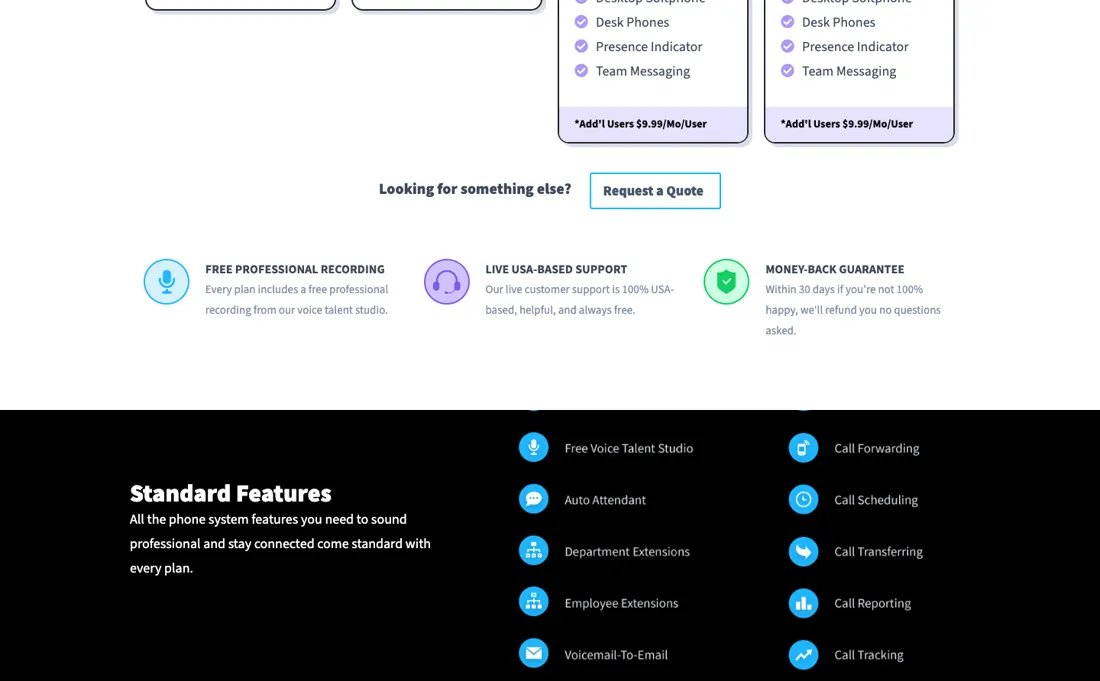
What that buys is narrow, and their FAQ states it plainly: besides users and minutes, the only difference is that Office lets a user sync a softphone or a desk IP-phone to their extension, and it adds presence and team messaging. So the question is not how big your team is but whether anyone needs a physical desk phone or a desktop softphone. If calls land on mobiles and forwarded numbers, Team is the plan and Office is an expensive way to buy nothing.
One caveat on the annual discount: the page says extras added after an annual term starts are billed monthly, so add-on users do not get the 30% unless you prepay them through support. One thing the page does not settle. All three cards read "Unlimited Minutes", but the FAQ answer to "What happens if I go over my plan's minutes?" offers to "simply pay 3.9¢ per minute for additional minutes on any plan".
The same FAQ still points at an "Office-Max" plan the page no longer sells, so this reads like leftover text from the older metered line-up rather than a hidden cap. Either way the page contradicts its own cards, and if call volume is the reason you are buying, get the unlimited claim confirmed in writing before you commit to a year.
Our monthly capture read this vendor's pricing page in July 2026 and again in August 2026, and the amounts were the same both times. We keep watching — the registry records what moves.
How to actually use UniTel Voice
Count your users first, because the seat model decides this and not the price ladder. Team is $19.99 a month and carries unlimited users. Office is $29.99, includes three, and charges $9.99 for each person after that — so four people on Office is $39.98 and ten is $99.92, against $19.99 on Team either way. Then check whether anyone actually needs what Office adds. Their FAQ is explicit: besides users and minutes, the only difference is that Office lets a user sync a softphone or a desk IP-phone to their extension, plus presence and team messaging.
If your calls land on mobiles and forwarded numbers, that is nothing you will use. Use the 30-day money-back window to test the thing that actually matters: call quality and the auto-attendant, on the devices and networks your team really uses. There are no contracts, so annual billing at 30% off is a straightforward saving once you know the calls hold up — take it in month two rather than month one.
One footnote: extras added after an annual term starts are billed monthly, so added seats do not get the discount.
Distilled from www.unitelvoice.com/pricing read on 9 September 2026 — the three plan cards (Solo, Team, Office) in both the monthly and the annual billing state, the per-plan price values the page carries for each state, and the pricing FAQ, including the answers on what separates the plans, on adding users to the Office plan at $9.99 each, and on how annual billing treats services added later.
The natural comparison is Grasshopper or Google Voice — Grasshopper is a close, pricier equivalent; Google Voice is cheaper but barer — UniTel's Team tier, unlimited users at $19.99, is the value play.
More on UniTel Voice
Everything we publish about UniTel Voice links back here — the review stays the honest hub:
The ex-banker filter — the same yardstick on every review (how we review): My ex-banker filter is simple: does UniTel Voice remove a real cost — time, errors, missed revenue — bigger than what it charges?
Frequently asked questions
What does UniTel Voice cost?
$9.99 a month for Solo, $19.99 for Team and $29.99 for Office, or $6.99, $13.99 and $20.99 on annual billing, which takes 30% off. Every plan carries one phone number and unlimited minutes, with a 30-day money-back guarantee and US-based support. Read on their own pricing page on 9 September 2026 — the Start-Up, Unlimited and Office-Max plans our August capture recorded are no longer offered.
What does it cost for a team rather than one person?
The plan price is not the team price. Additional users on the Office plan are $9.99 per user per month on top of the plan fee, and you can add them at any time after signing up. For a five-person office that is the plan plus four extra seats, so work from the seat count rather than the headline.
Are the minutes really unlimited?
The three plan cards all say "Unlimited Minutes", and that is what you are buying. Their pricing FAQ muddies it: asked what happens if you go over the minutes on your plan, it answers that you can "simply pay 3.9¢ per minute for additional minutes on any plan". That same FAQ still refers to an Office-Max plan the page no longer sells, so it looks like text left over from their older metered plans — but they have not cleaned it up, so ask support to confirm before you prepay for a year.
Is there really no contract?
That is what the page states, alongside a 30-day money-back guarantee — if you are not happy within thirty days they refund without questions. Annual billing is optional and is what buys the 30%-plus discount, so the trade is the usual one: commit for a year to pay less, or stay monthly and keep the exit.
What should I weigh before buying Communication & Voice software?
Generally yes, since this category is built for it, but the details that bite are timezone handling, how per-seat cost scales as the team spreads, and whether numbers, routing or coverage exist in the countries your people actually sit in. Availability varies far more by country than the marketing pages suggest, so check your specific regions before committing.
Is this a hands-on review of UniTel Voice?
This is a researched assessment, not a hands-on test — where we've used a tool ourselves, we say so explicitly. We name what each tool is genuinely good and bad at, and we earn a commission only if you sign up, at no cost to you.
- Buyer reviews on G2, Capterra, Software Advice and Research.com, read August 2026.
- Re-verified 2026-09-09 on unitelvoice.com/pricing.
- A dated screenshot of that pricing page, kept on this site as the receipt.
Others in this category
Reviewed communication & voice tools that share ground with UniTel Voice — comparable in what they do, not drop-in swaps:
New dossiers, cost-traps we found, and tools that earned a keep — no hype, no sponsored-disguised-as-advice. Unsubscribe anytime.
This is our researched assessment — not a paid placement. The “Visit” links on this page are affiliate links: we may earn a commission if you sign up, at no extra cost to you, and it never changes our take. How we review →