Vida AI Review (2026)AI Phone Agents From $250 a Month
 By Daan Haket · Researched and written with an AI assistant · who does what
The $250 Starter fee buys the platform and one agent, not the calls: every voice minute is $0.15, AI tokens are billed on top by model, a second agent is another $250 a month, and one-time setup fees may come in a quote.
service businesses, agencies and MSPs that want AI phone agents to answer, qualify or schedule calls, with enough call volume to plan usage month by month and someone to set the agent up.
you want a flat price with calls included, since every minute and token is metered; you take a few calls a week and $250 a month for the platform alone outweighs them; or your call flows are too high-stakes to automate yet.
Transparency: the “Visit” links on this page are affiliate links — we may earn a commission if you sign up, at no extra cost to you. No vendor can pay for a better review or verdict. How we make money →
Pricing (2026)
✓ Pricing re-verified 17 Oct 2026
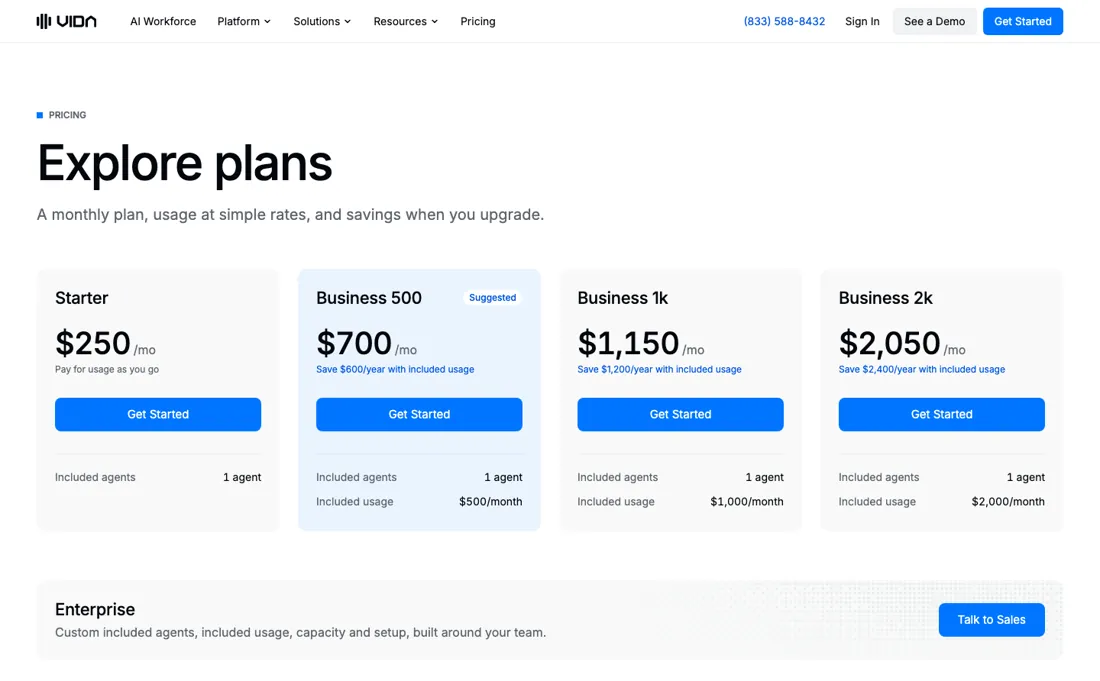
Vida now publishes a monthly plan ladder. Starter is $250 a month with 1 agent and no included usage: you pay for usage as you go. Business 500 is $700 a month with 1 agent and $500 of usage included each month, Business 1k is $1,150 with $1,000 included, and Business 2k is $2,050 with $2,000 included; Vida labels these as saving $600, $1,200 and $2,400 a year.
Enterprise is quoted. Usage rates are the same on Starter and Business: voice $0.15 a minute, billed in 60-second increments; outbound text messages $0.06 each, inbound free; and AI tokens billed by model per million tokens, from $0.10 input and $0.80 output for GPT-5 Nano to $20.00 input and $100.00 output for the largest models listed. Add-ons on any plan: additional agents $250 per agent a month, phone numbers $5 per number a month and Text Messaging $25 a month; premium support, advanced privacy, SOC 2 security, outbound and managed agents are quoted.
Full pricing notes (2 more paragraphs)
The FAQ says the included usage is a dollar allowance shared across all agents that does not roll over, and usage above it is billed at the same rates. There is no plan or platform setup fee, but one-time setup fees may apply to the agents and add-ons you choose and are itemised in a quote. Downgrades generally take effect at renewal, and SMS registration may take up to two weeks.
Correction to our own earlier dossier: an agency ladder of about $750 a month for 5 agents and roughly 2,500 AI voice minutes, plus platform plans from about $2,500 and the per-minute rate we derived from them, appeared nowhere on vida.io when we checked on 10 September 2026; the plans above are the first prices Vida itself has published.
Plans change — always verify the live price on their site.
Category context: Communication & Voice. Across the 22 tools in this category that we researched with a public US-dollar price, the median entry price is about $30 a month (lowest paid plan as listed, per seat where the vendor prices per seat). Vida AI’s entry price of $250 a month sits above that median. Compare pricing conditions in the Software Cost Atlas →
What the pricing page doesn’t say
Business allowances do not roll over, and the terms rule out refunds. And the universal truth of voice AI: demo calls are rehearsed, your callers aren't, so test it on your real call types (accents, interruptions, edge requests) before betting the front desk on it.
Watch the video review
The video version of this review, from our YouTube channel.
⚡ Short on time? Watch the 30-second verdict Short.
What Vida AI does
Deploy autonomous frontline voice agents. Let AI answer calls, book appointments, and handle FAQs 24/7 without sounding robotic.
What buyers report about Vida AI
Hands-on: not tested by usReported by buyers: Slashdot and platform documentation, read August 2026
Themes from the buyer-review sites listed at the foot of this page, read in August 2026. We have not run Vida AI ourselves, so this is other buyers' experience rather than ours. We summarise it here because the complaints are usually the part a vendor page leaves out.
- • An AI phone agent that answers, texts, books appointments and runs around the clock — over 100 million customer interactions across tens of thousands of businesses.
- • The Core plan bundles 5 agents, 2,500 voice minutes, 2,500 outbound messages, full API access and white-glove support.
- • As of mid-2026 there are zero independent user reviews anywhere. That is the most important thing on this page — there is no outside evidence to lean on, so trial it against your own call volume.
- • In August 2026 reviewers quoted $500 a month with monthly billing only, no free plan and no trial, which prices out solo operators and low-volume businesses; since the September 2026 reading vida.io publishes no plan prices at all and sells a quoted pilot instead (see the pricing section).
- • There is no annual option, so no discount for committing.
Business is Starter plus prepaid usage, at a discount
Each Business plan is the $250 Starter fee plus a usage allowance, minus a discount: Business 500 at $700 is $250 plus $500 of usage, less $50 a month, and the 1k and 2k plans take $100 and $200 off. That matches the yearly savings Vida prints on the cards; the arithmetic is ours. Because unused allowance does not roll over, a Business plan only pays if you use most of it every month.
Business 500 beats Starter once your usage passes $450 a month. On voice alone at $0.15 a minute that is 3,000 minutes, about 100 minutes a day, before AI tokens, which are billed on top by model and depend on which model the agent runs on and how long it talks. Run a month on Starter, read the real usage bill, and only then choose an allowance. Every plan includes one agent.
A second agent is $250 a month, so a set-up with a receptionist and a separate scheduling agent starts at $500 a month before any calls. Ask for the one-time setup fees in writing before you start; the FAQ says they depend on the configuration.
Our monthly capture read this pricing page in July 2026 and again in August 2026. In July the page published a full rate card — per agent, per minute, per message, per token. In August all of it was gone, replaced by an invitation to design a pilot. The product did not necessarily get dearer; it got harder to price without talking to sales.
How to actually use Vida AI
Start on Starter with one agent and one call type, the one that costs you most today, such as missed calls after hours or appointment requests. Before you sign, ask Vida for the one-time setup fees for that agent; the FAQ says they are itemised in a quote and depend on the configuration. Pick the AI model deliberately. The rate card prices tokens per model, and the gap between the cheapest and the most expensive model listed is more than a hundredfold, on top of $0.15 for every voice minute.
Measure containment during the first month, the share of calls fully handled without a human, per call type rather than as one average, because one good category hides a bad one. Then read the usage bill and decide whether a Business allowance would be cheaper. If texting is part of the plan, add the Text Messaging add-on early and allow the two weeks the FAQ gives for SMS registration. And keep your own copy of call data through the API or a CRM integration while you use it.
Where this section comes from: our research notes (106 words)
Vida's own pages. Re-read 17 October 2026 in a browser: vida.io/pricing with all FAQ answers expanded (plans, add-ons, usage rates, setup fees, plan changes, SMS registration) and the rate card at vida.io/rate-card (voice, messages, phone numbers and token rates per model, 'effective October 14, 2026'). The pilot process with an investment from $1,500 that this review described from 10 September to 13 October 2026 is no longer on the pricing page.
Cancellation, refunds, fair use and data after cancellation were read on 13 October 2026 in Vida's terms of use (vida.io/terms) and its FAQ (vida.io/faq). The plan arithmetic is ours. We have not used Vida ourselves.
The natural comparison is Synthflow or Retell AI — builder-oriented voice-AI platforms — Vida's edge is the reseller/white-label model; compare per-minute economics at your projected volume.
Frequently asked questions
Can I cancel, and is anything refunded?
You can cancel at any time through the site or by emailing help@vida.io, but nothing is refunded. Vida's terms of use (vida.io/terms, read 13 October 2026) say a subscription renews automatically month-to-month at the agreed rate unless you cancel before it renews, that fees are billed in advance and are non-refundable, and that there are no refunds for cancellation or non-usage; the FAQ says the same. The pricing FAQ (read 17 October 2026) adds that downgrades generally take effect at renewal.
What happens to my call data if I leave?
Plan to take it out before you go. The terms (read 13 October 2026) say all data on Vida's servers may be deleted after the account is cancelled and that retrieval may not be possible, and the FAQ says a deleted account and its data cannot be recovered; turn off call forwarding at your carrier first. No export process is described in either, so a bulk export at exit is not confirmed. The FAQ does say phone agents can send call data to external systems through the API or a CRM integration, which is the way to keep your own copy while you use it.
What happens if I use more than my included usage?
You pay for it. The pricing FAQ (read 17 October 2026) says usage above the Business allowance is billed at the applicable rates, $0.15 a voice minute plus AI tokens by model, and that unused allowance does not roll over. The terms (read 13 October 2026) also allocate 'a reasonable amount' of tokens, minutes and messages per billing cycle and allow usage well above typical patterns to be limited or suspended.
Is this a hands-on review of Vida AI?
This is a researched assessment, not a hands-on test — where we've used a tool ourselves, we say so explicitly. We name what each tool is good and bad at, and we earn a commission only if you sign up, at no cost to you.
- Buyer reviews on Slashdot and platform documentation, read August 2026.
- Re-verified 2026-10-17 in a browser on vida.io/pricing with its FAQ and on vida.io/rate-card; the page has changed since our reading of 13 October 2026, when it published no plans and only a scoped pilot from $1,500, and the rate card says its rates took effect on 14 October 2026.
- A dated screenshot of that pricing page, kept on this site as the receipt.
Others in this category
Reviewed communication & voice tools that share ground with Vida AI — comparable in what they do, not drop-in swaps:
New reviews, price changes we recorded, and the cost conditions we found. No sponsored placements. Unsubscribe anytime.
This is our researched assessment — not a paid placement. The “Visit” links on this page are affiliate links: we may earn a commission if you sign up, at no extra cost to you, and it never changes our take. How we review →